



Install Steam
sign in
|
language
简体中文 (Simplified Chinese)
繁體中文 (Traditional Chinese)
日本語 (Japanese)
한국어 (Korean)
ไทย (Thai)
Български (Bulgarian)
Čeština (Czech)
Dansk (Danish)
Deutsch (German)
Español - España (Spanish - Spain)
Español - Latinoamérica (Spanish - Latin America)
Ελληνικά (Greek)
Français (French)
Italiano (Italian)
Bahasa Indonesia (Indonesian)
Magyar (Hungarian)
Nederlands (Dutch)
Norsk (Norwegian)
Polski (Polish)
Português (Portuguese - Portugal)
Português - Brasil (Portuguese - Brazil)
Română (Romanian)
Русский (Russian)
Suomi (Finnish)
Svenska (Swedish)
Türkçe (Turkish)
Tiếng Việt (Vietnamese)
Українська (Ukrainian)
Report a translation problem



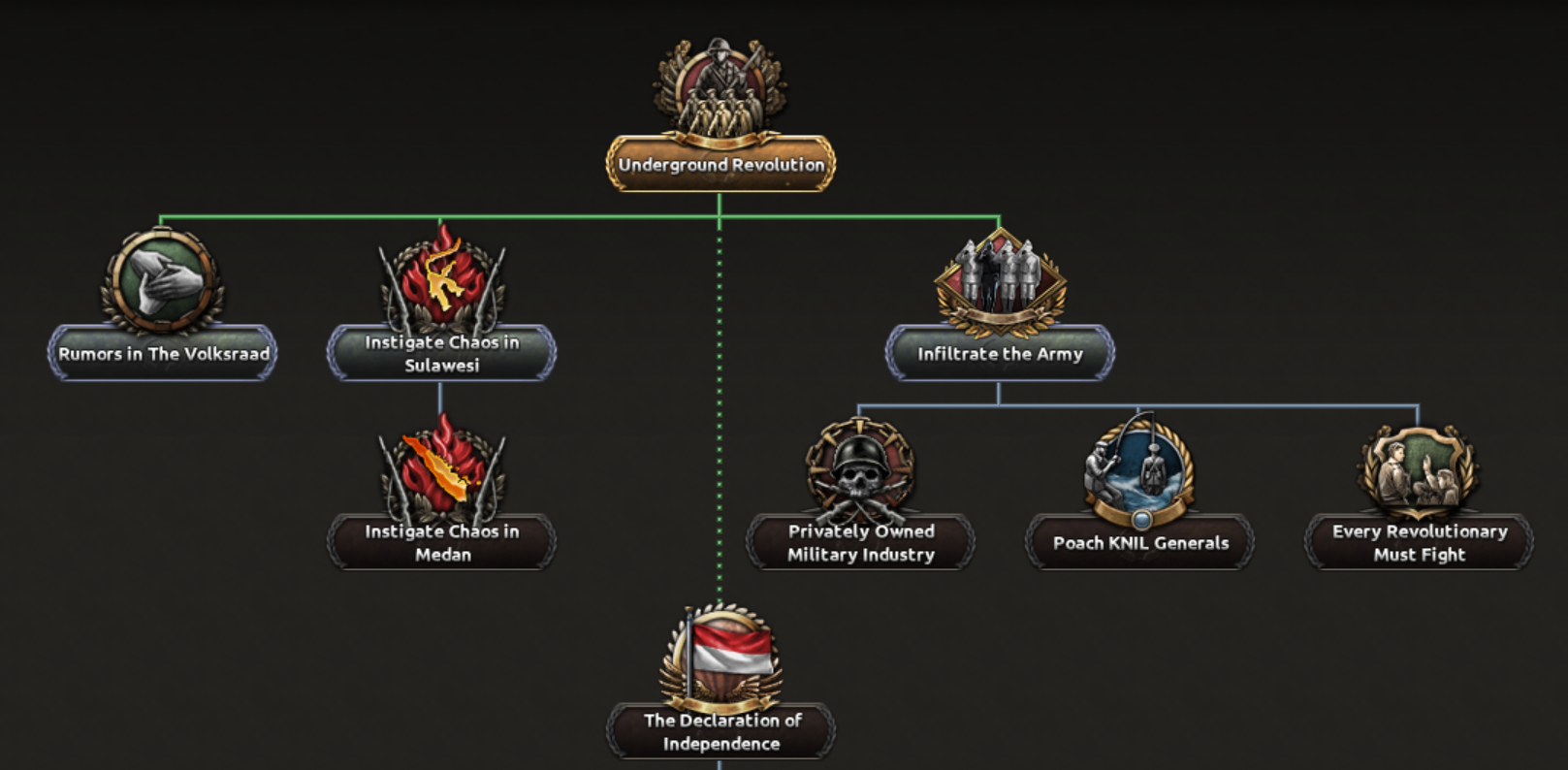
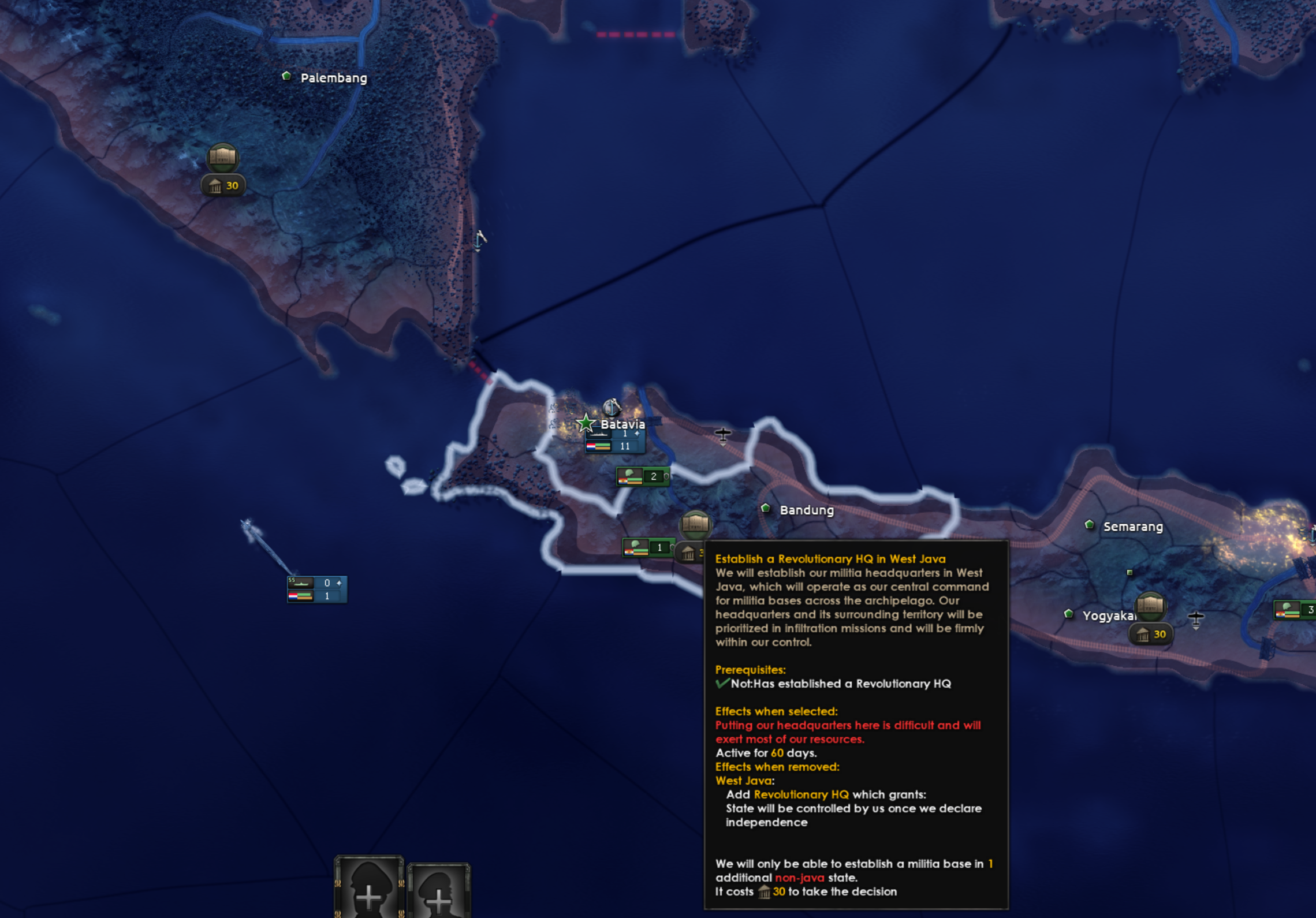 After beginning the Underground Revolution branch, you will select a few states to establish militia bases, of which one will be your headquarters. These states will be under your control once the revolution starts. The exact number of bases is dependent on the states you select. Putting an HQ in Java is more costly than Sulawesi, for instance.
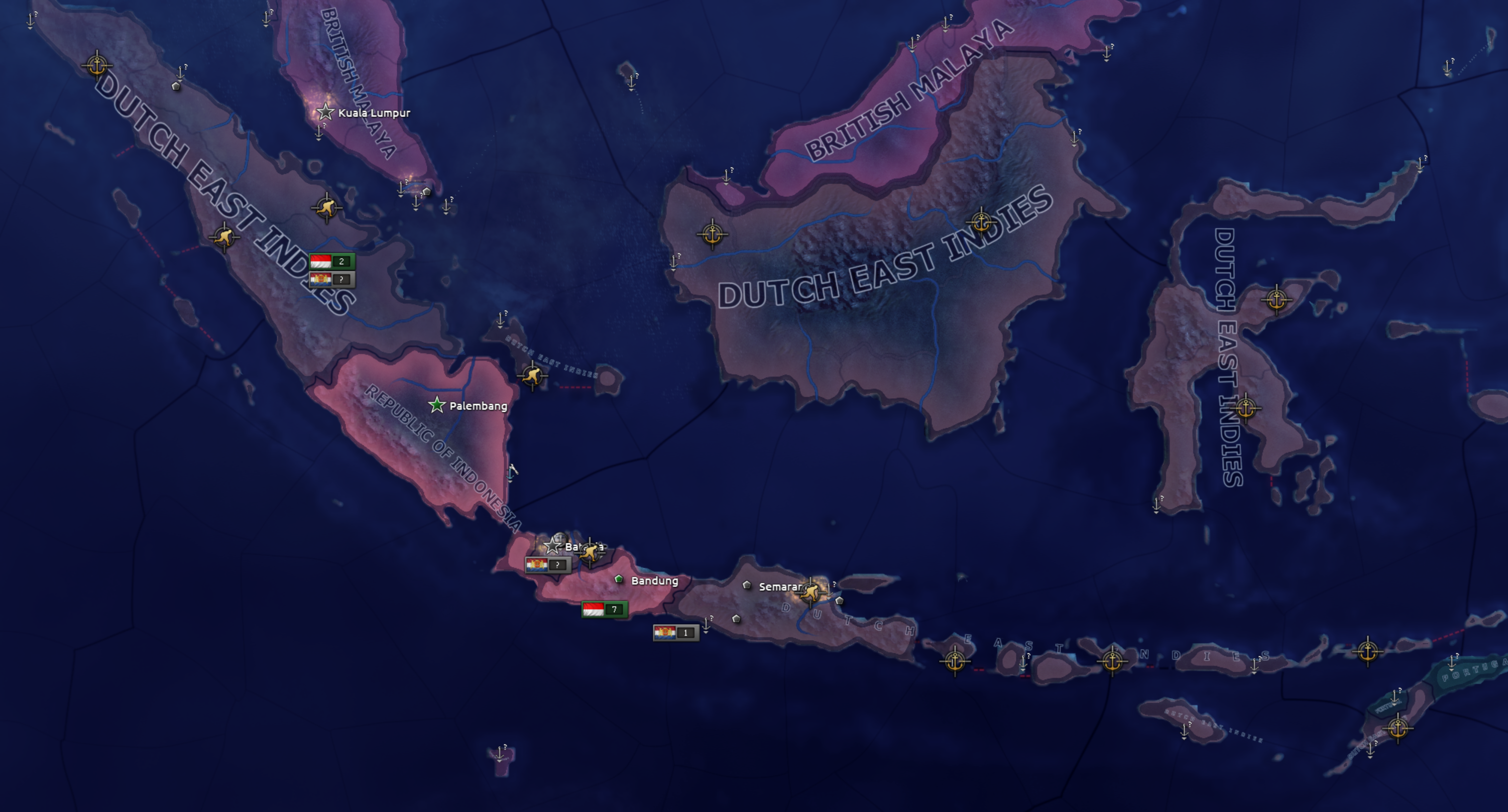 The second stage of the revolution begins after establishing all militia bases and finishing a focus. You are now independent, but the Netherlands does not recognize Indonesian sovereignty, instead seeing the Republic of Indonesia as rebels and criminals.
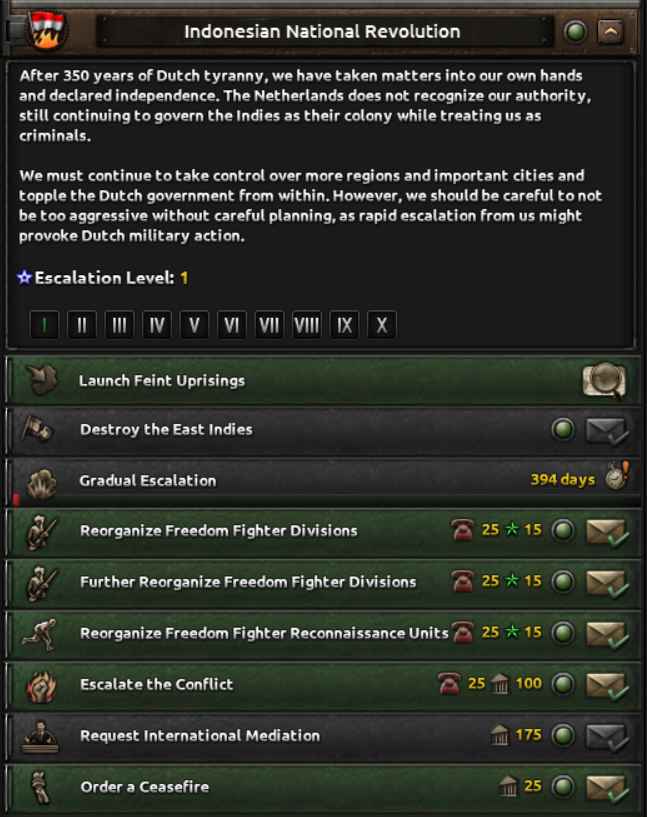 …Until we remembered we already have a system in the game that does pretty much exactly that. The Italian/Ethiopian Escalation System from By Blood Alone is perfect for Indonesia, so we decided to repurpose it.
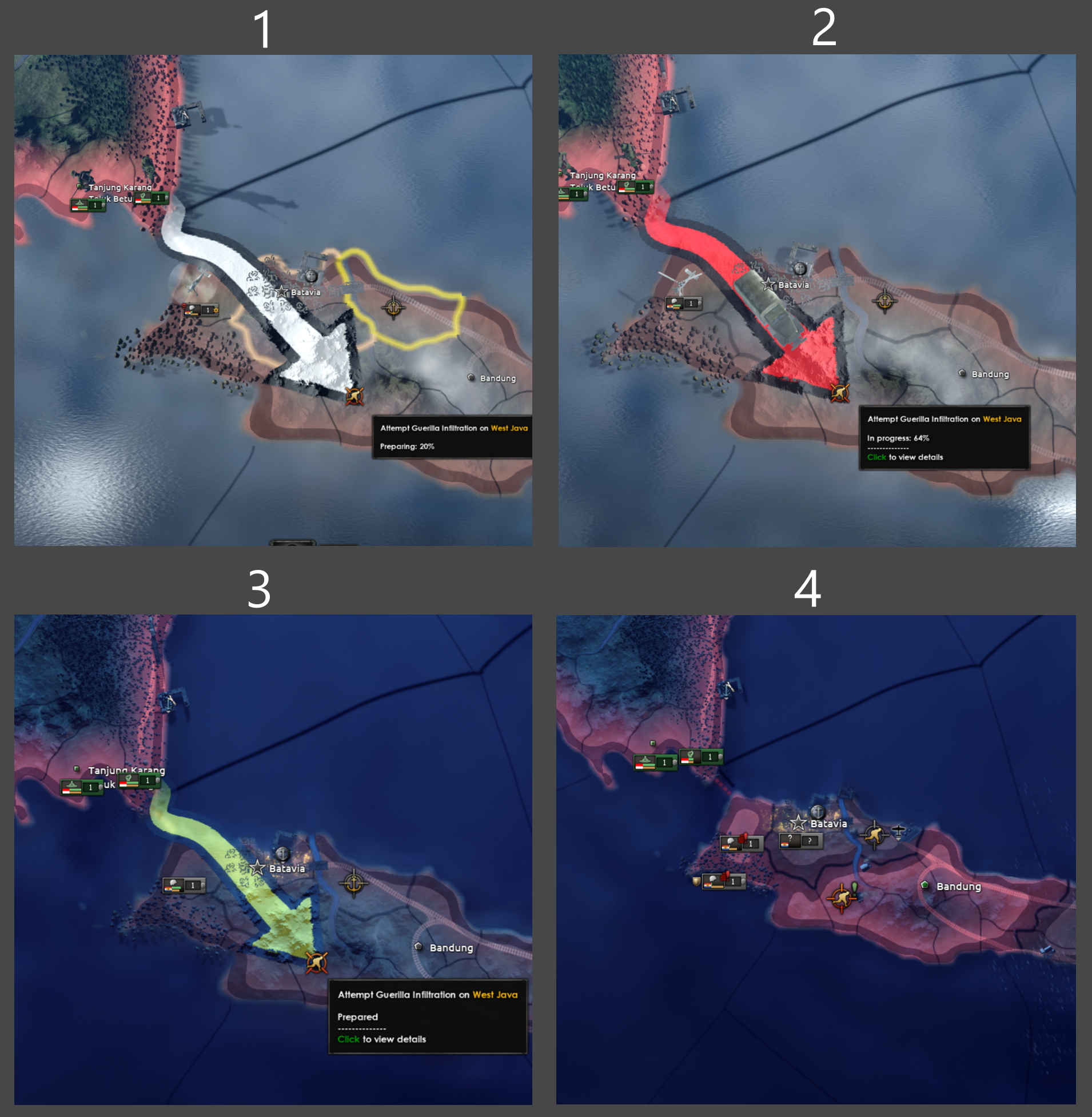 During this stage of the revolution where Indonesia and the Netherlands are not yet at war, Indonesia will have Land raids available to them which can be used to take control over Dutch-controlled Indonesian states.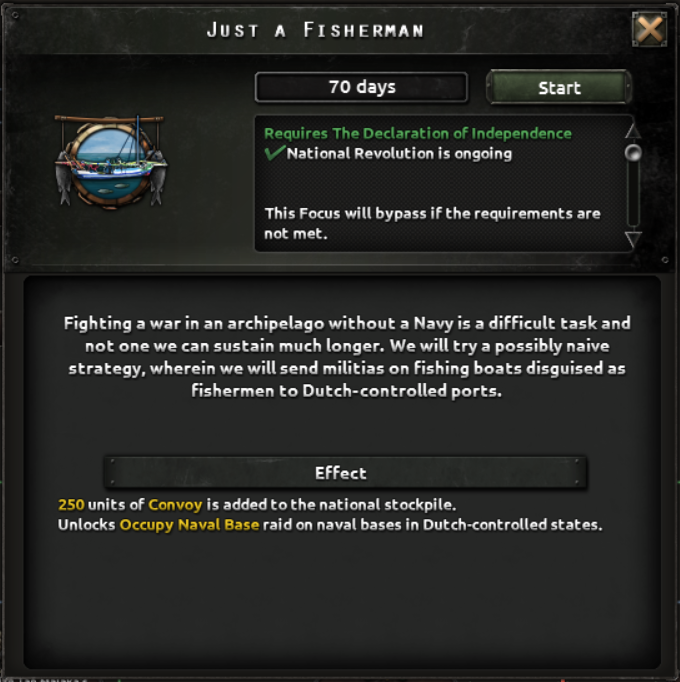
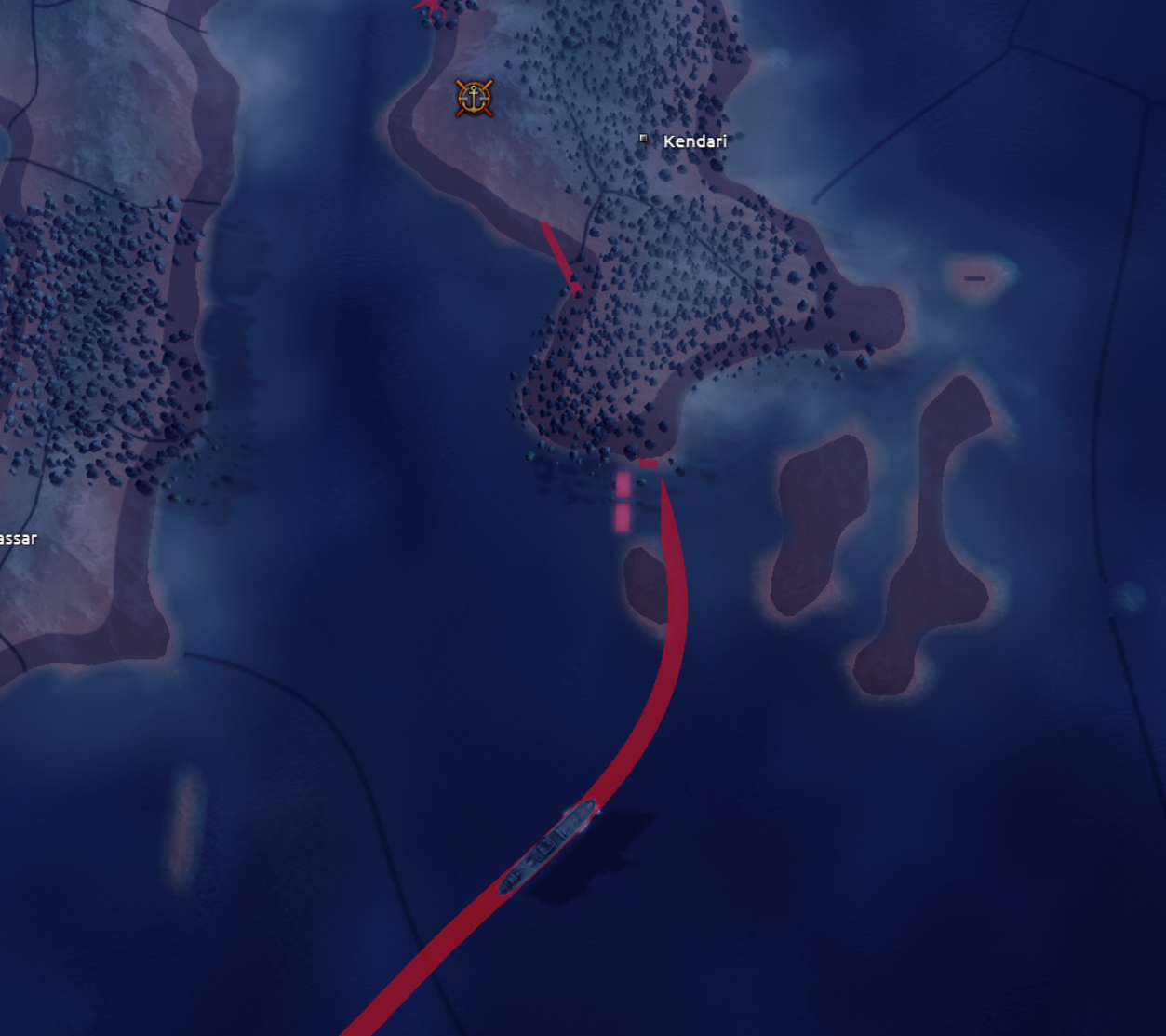 Our solution for this roadblock is Marine Commando Raids. Indonesia can use them similarly to the land raids to annex a state, however, they are extremely risky. A singular Dutch destroyer could easily take out the whole raiding fleet without effort, and therefore they require very careful planning and must be executed covertly, with raiding vessels being disguised as fishing boats.
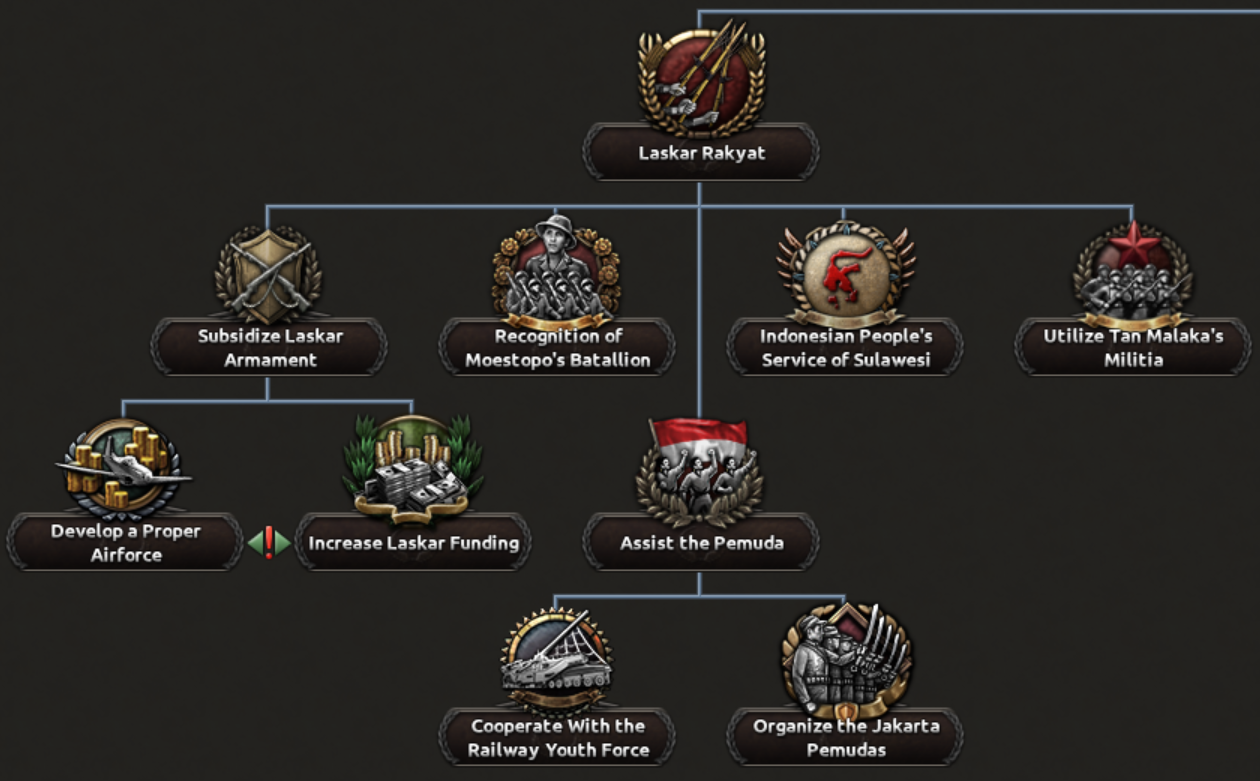 There are many armed militia groups of various sizes across the archipelago, known as Laskar. They are mostly autonomous and sometimes rival the government. Indonesia has focuses available to form alliances with these militia units, allowing them to be deployed as fully-manned, fully-equipped divisions.
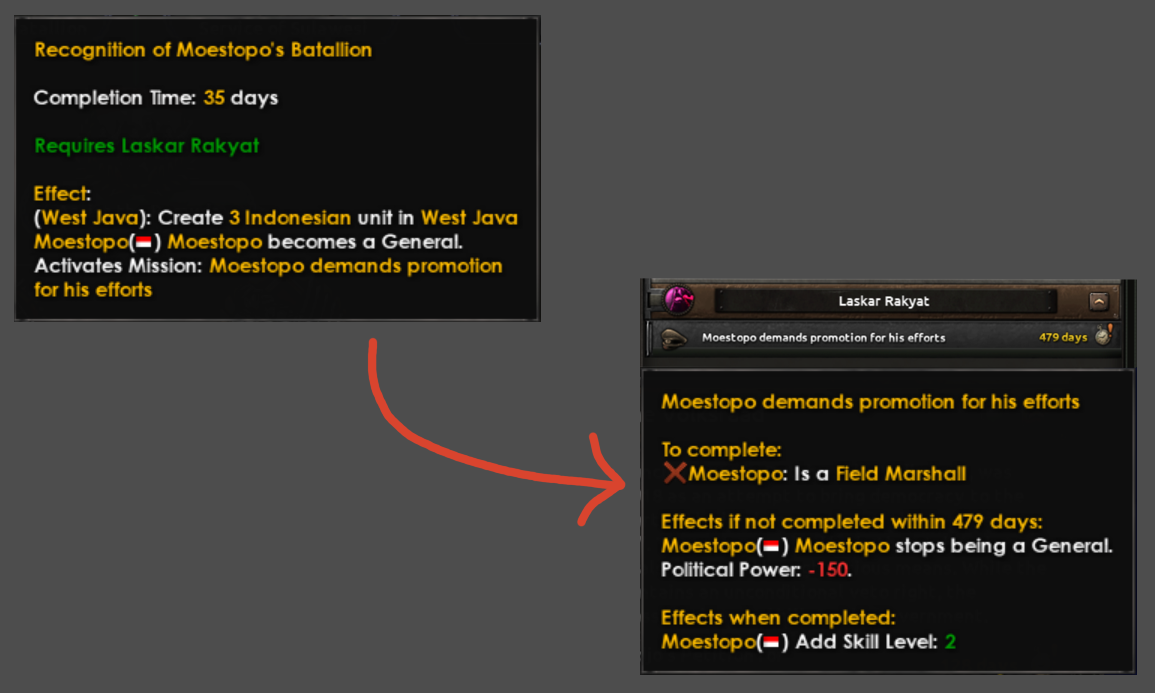 Each group of Laskar have their own ambitions, demands, and political ties. Their focuses tend to be quite powerful, but each comes with a demand, which if not met, will give Indonesia serious penalties to stability and political power.
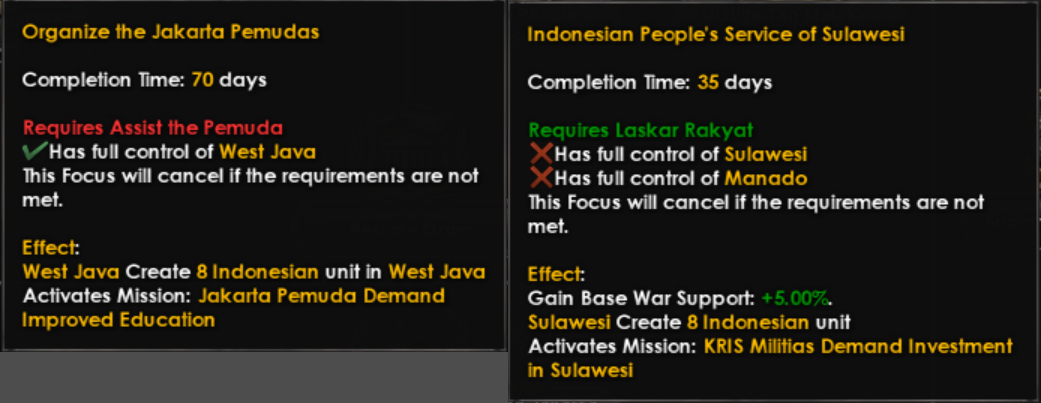 More examples
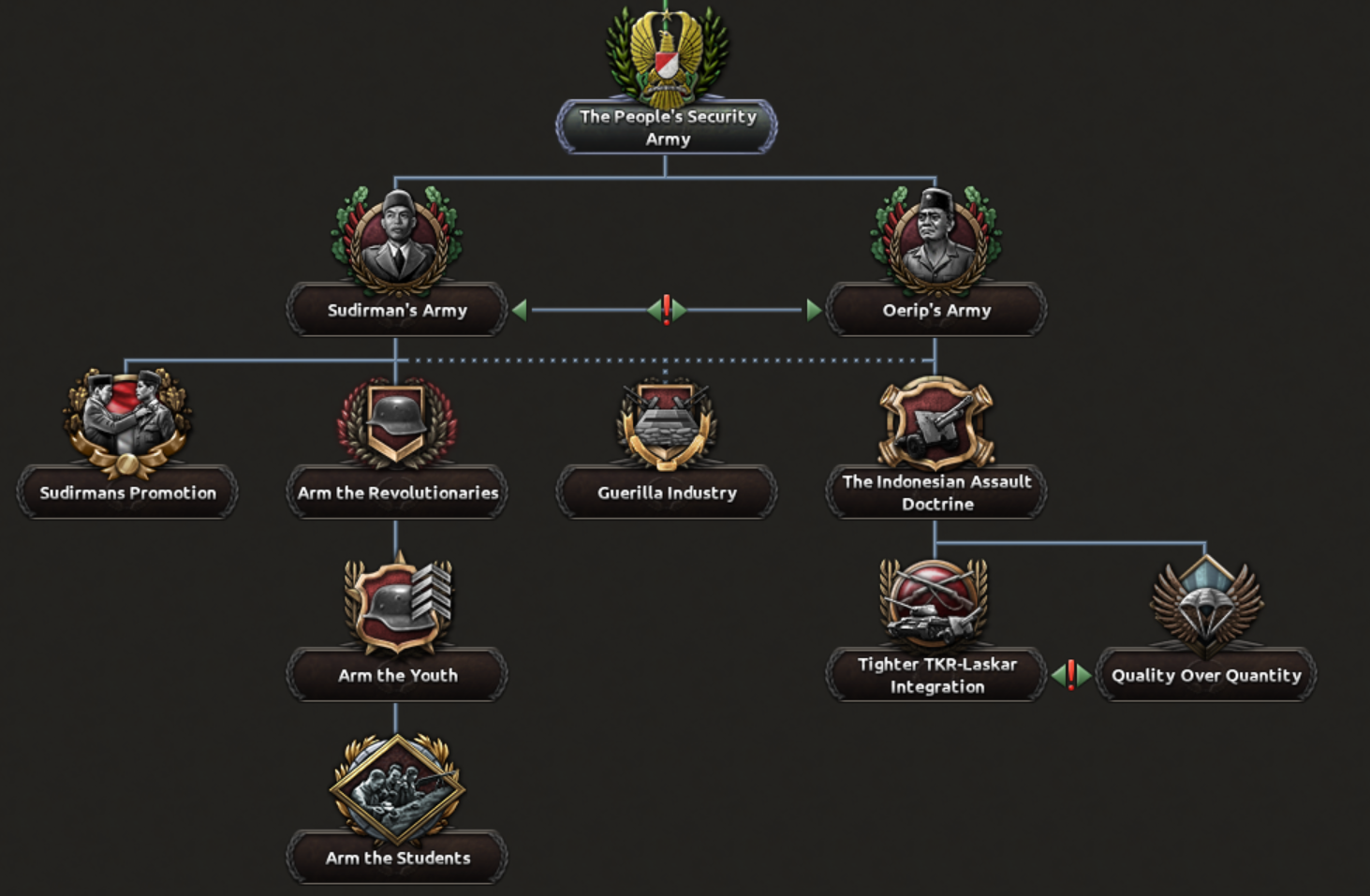 Historically, when the People’s Security Army was formed in 1945, a vote was held on who should become the Commander. This was an extremely close vote, requiring three rounds as in the first two they tied evenly. In the third round Sudirman won by a singular vote (22 to 21).
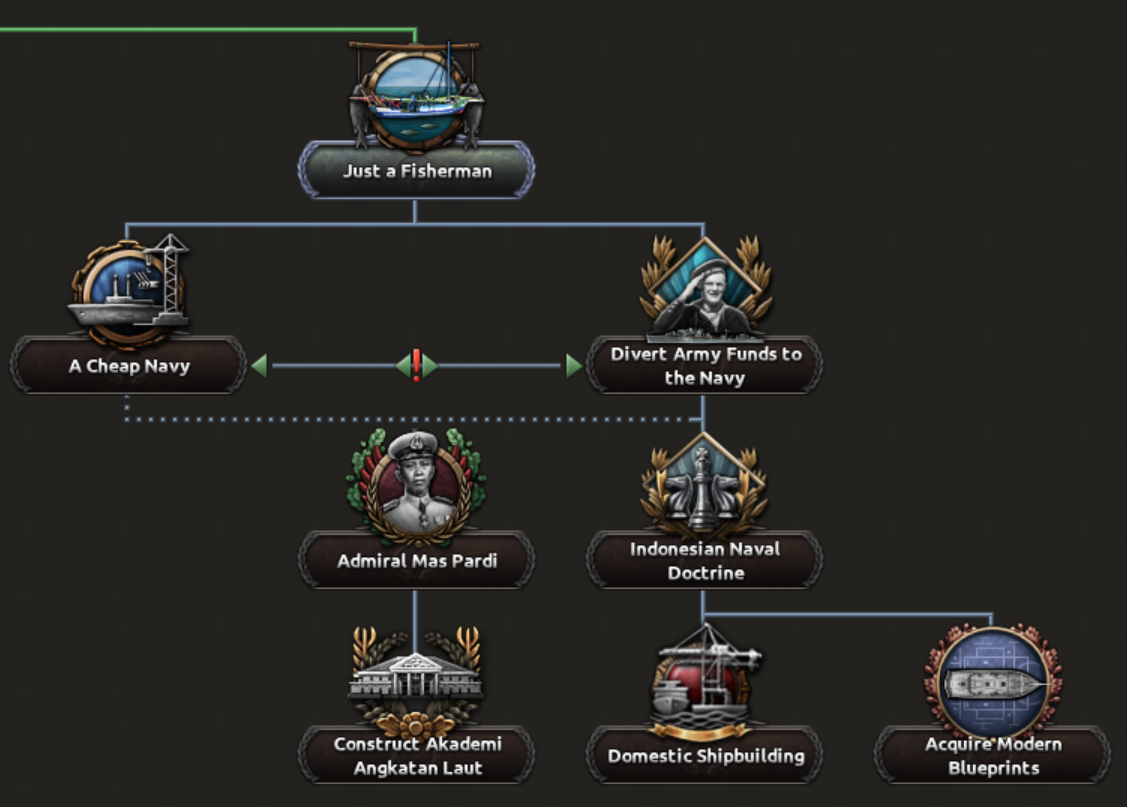 The Indonesian naval branch begins with two mutually exclusive focuses. “A Cheap Navy” is a 35 day focus which does not lead to any other unique focuses, and “Divert Army Funds to the Navy” is a 70 day focus which leads to several other focuses.
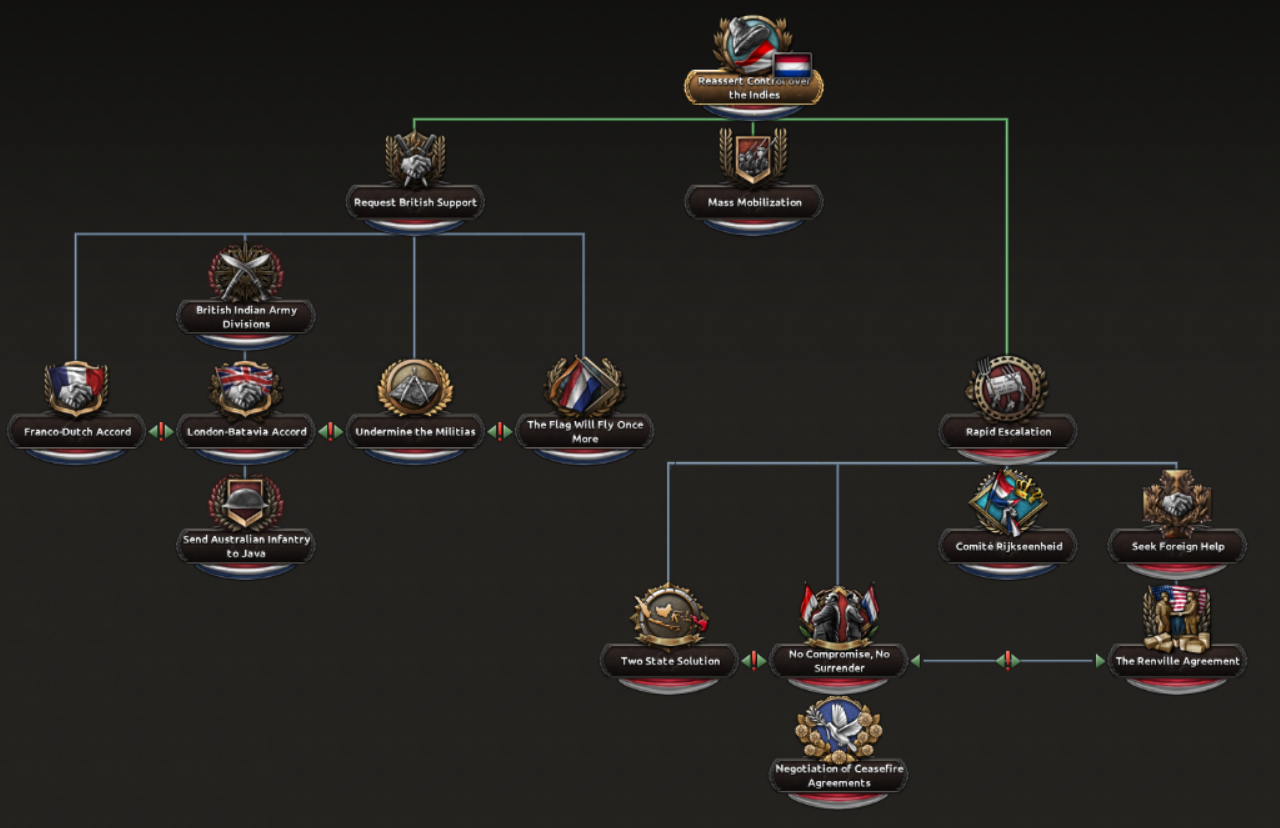 In order to help manage the flow of the conflict, we decided to add a small joint focus tree which is separate from the one found in the Loyalist path. Unlike other JFT’s, this one is focused on sabotaging each other rather than cooperating. Some focuses will give bonuses to the originator and penalties to the member.
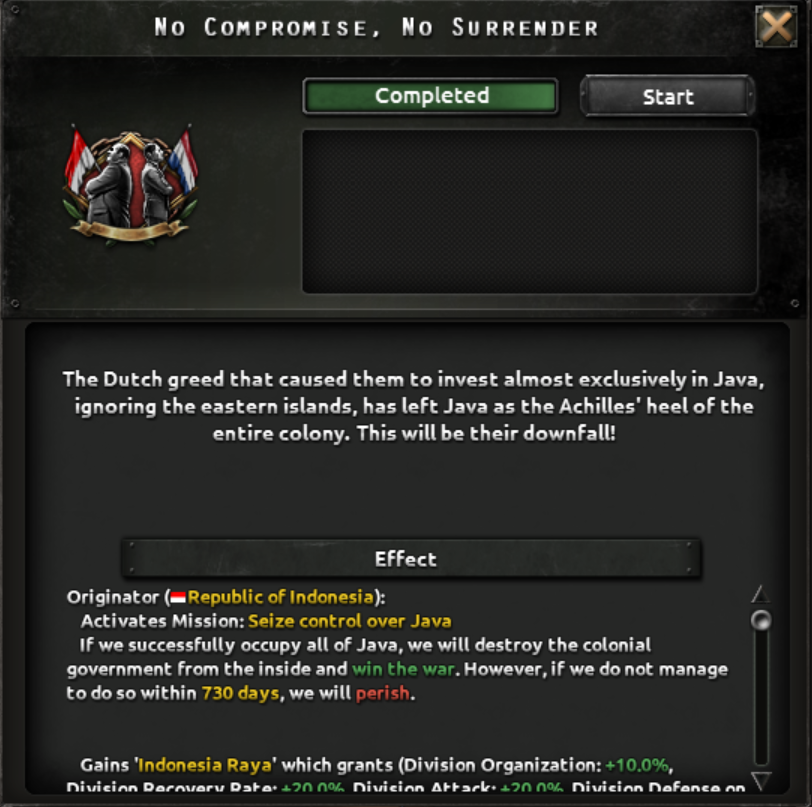 Another example is the focus “No Compromise, No Surrender”, which can be taken by Indonesia as a reaction to the Netherlands declaring war, giving them a set number of days to occupy all of Java and shut down the Dutch East Indies government to win the war.
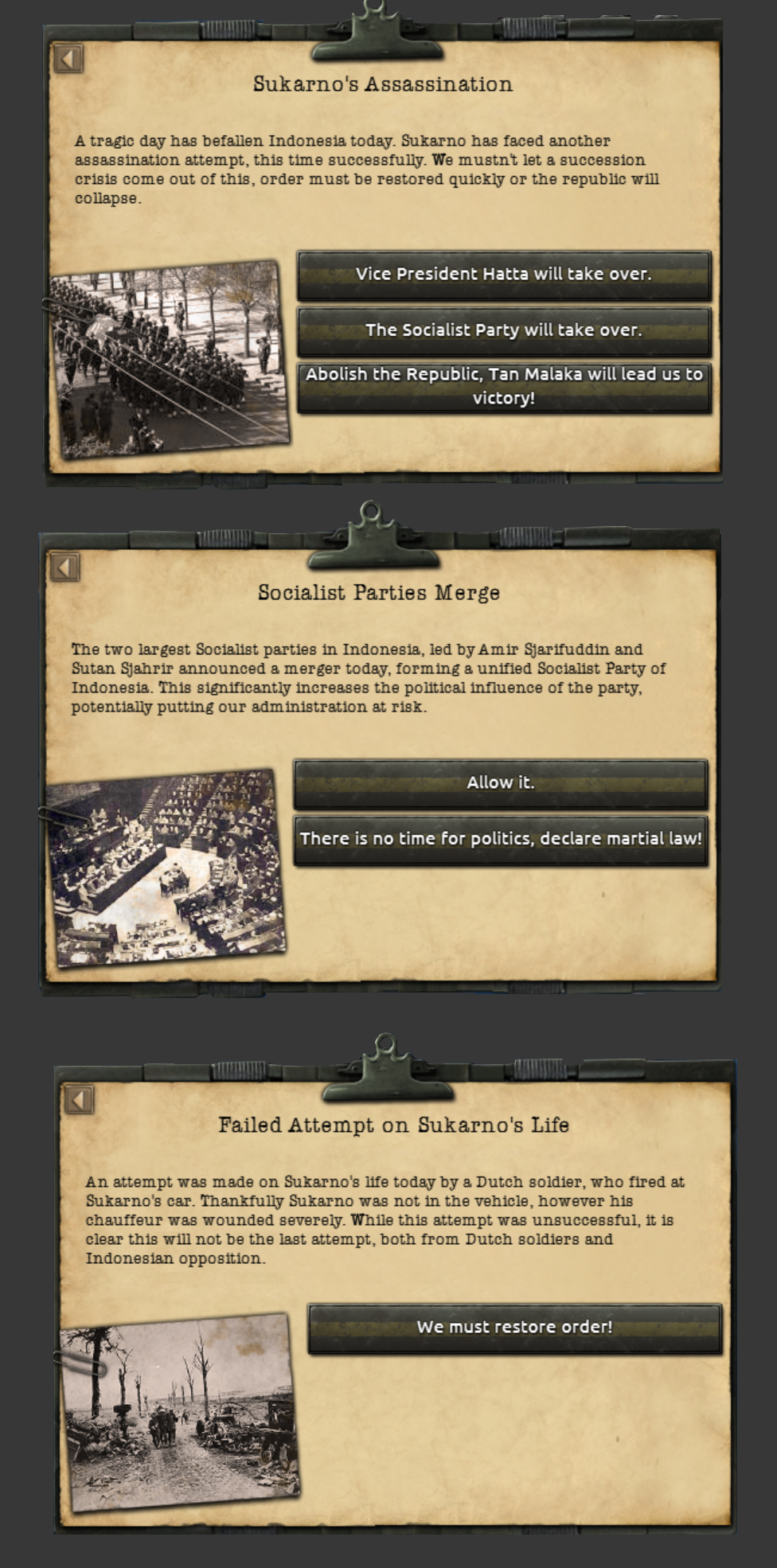 Historically, the Indonesian government at the time was quite hectic and a lot of infighting occurred. This is represented in-game via events that will fire periodically and as a result of escalation increasing. These events will have varying effects, which can be good or bad (usually both). Examples include stability loss, ideologies gaining or losing support, and unlocking new characters, depending on the option you choose.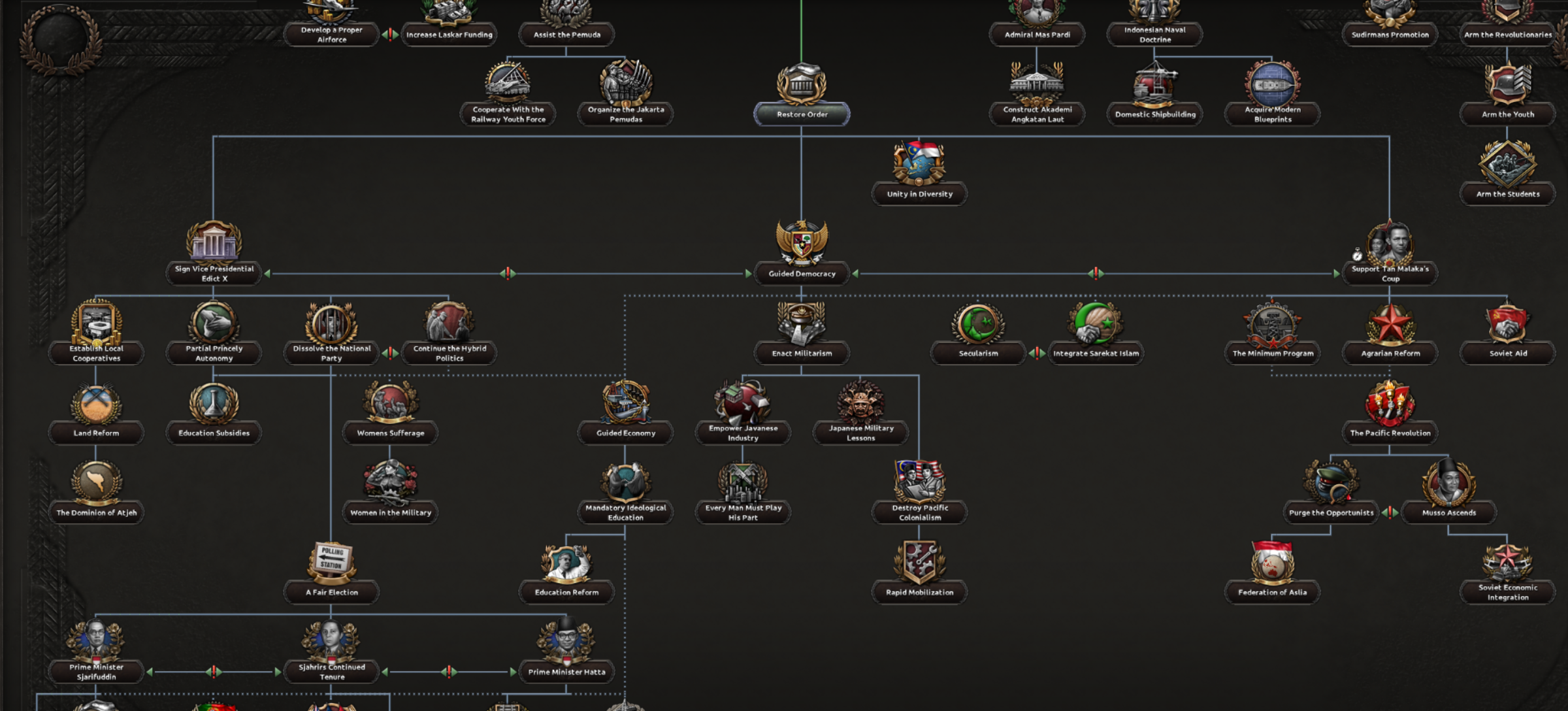
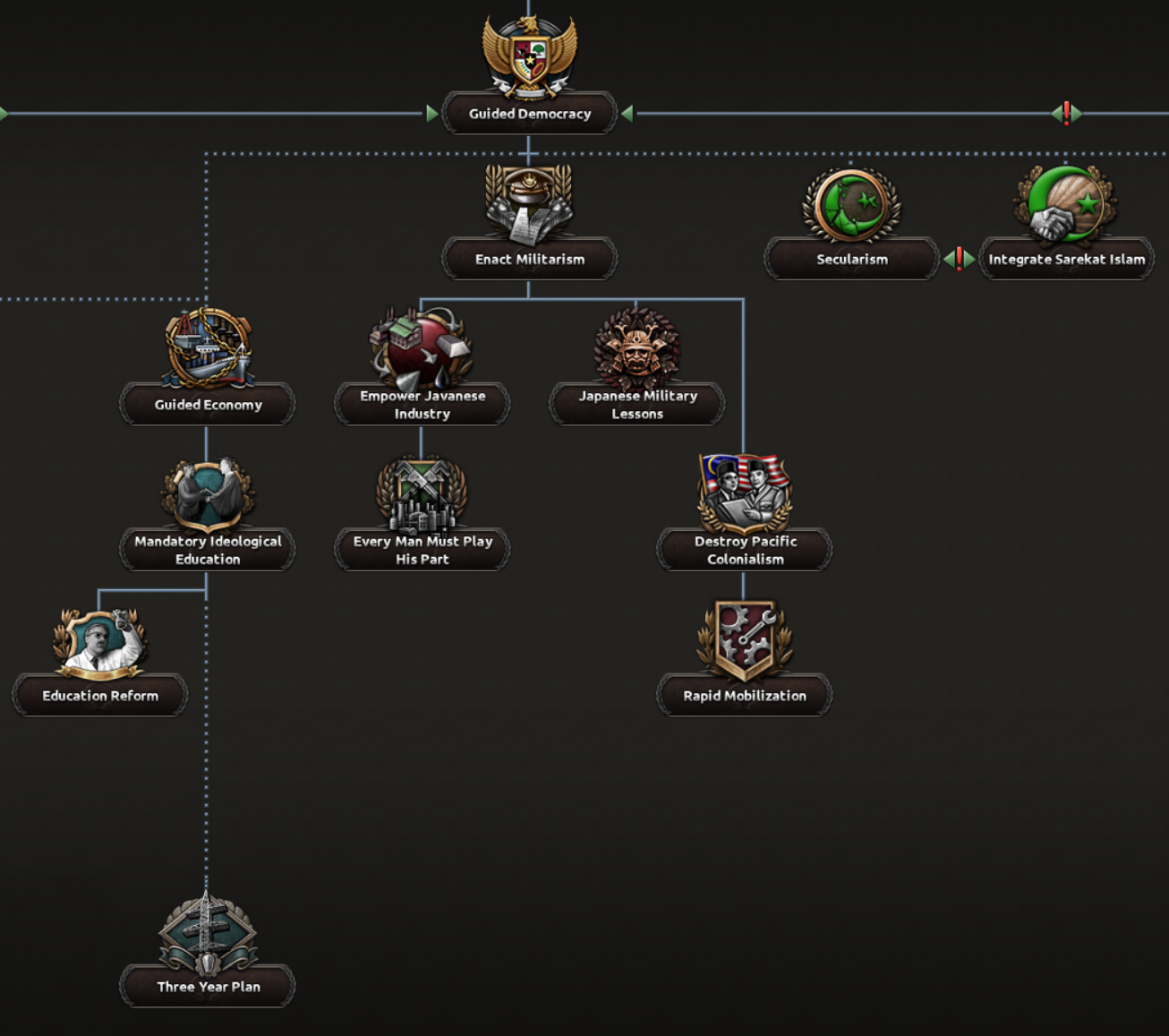 The Guided Democracy path requires unaligned support and will keep Sukarno as the country's leader. It contains focuses to militarize the nation as well as focuses to cooperate with Japan. This branch prioritizes playing tall rather than wide, and gives you several major economic bonuses.
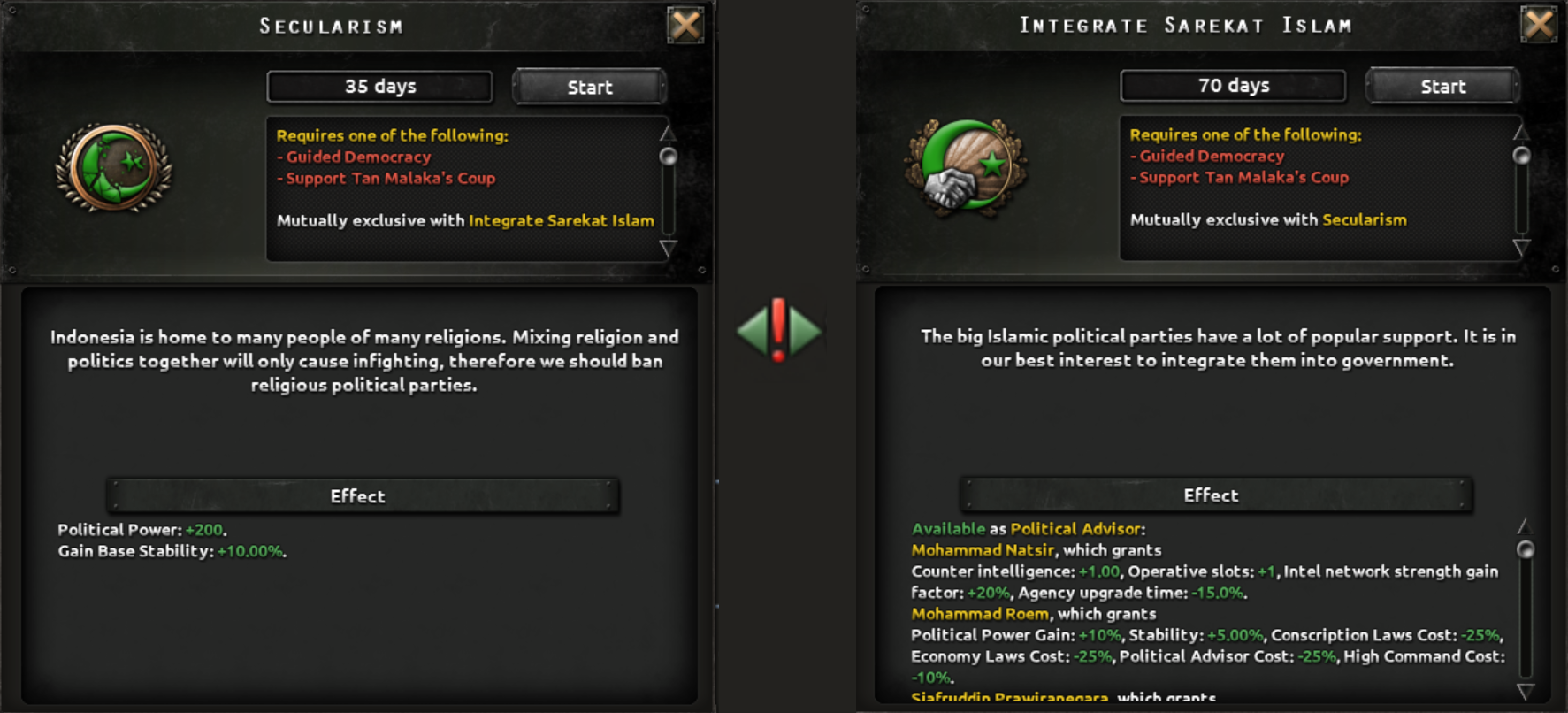 Shared with the communist branch are two mutually exclusive focuses to either go for a secular state or integrate the Islamic parties.
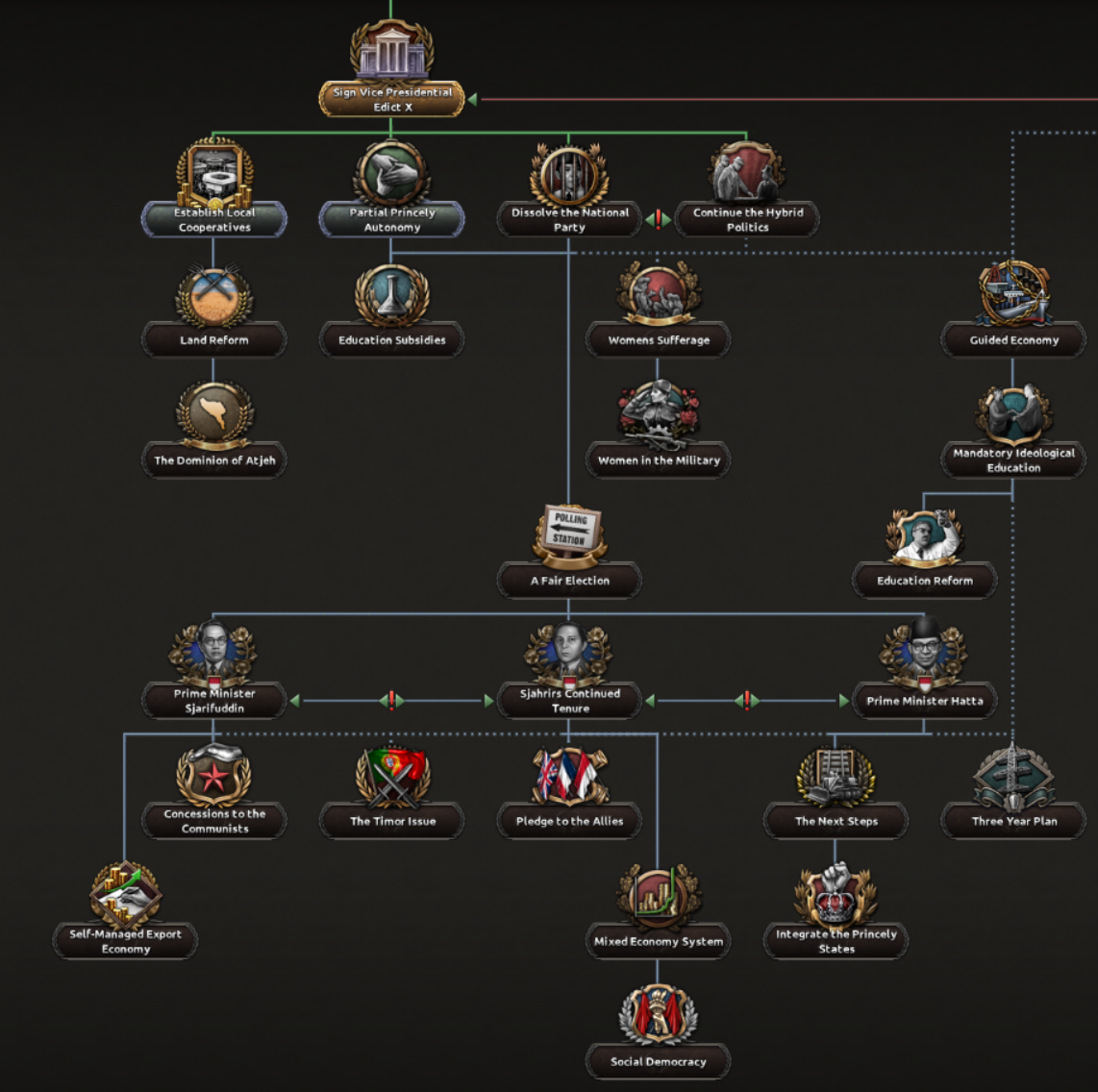 The Indonesian administration at the time was made up of the President, and the National Committee, which was an advisory council at first. However, after facing resentment and demands for a more even distribution of power, President Sukarno and Vice President Hatta signed the 10th Vice Presidential Edict, granting legislative power to the committee. This led to Indonesia having both a President and Prime Minister simultaneously, which were not necessarily from the same party.
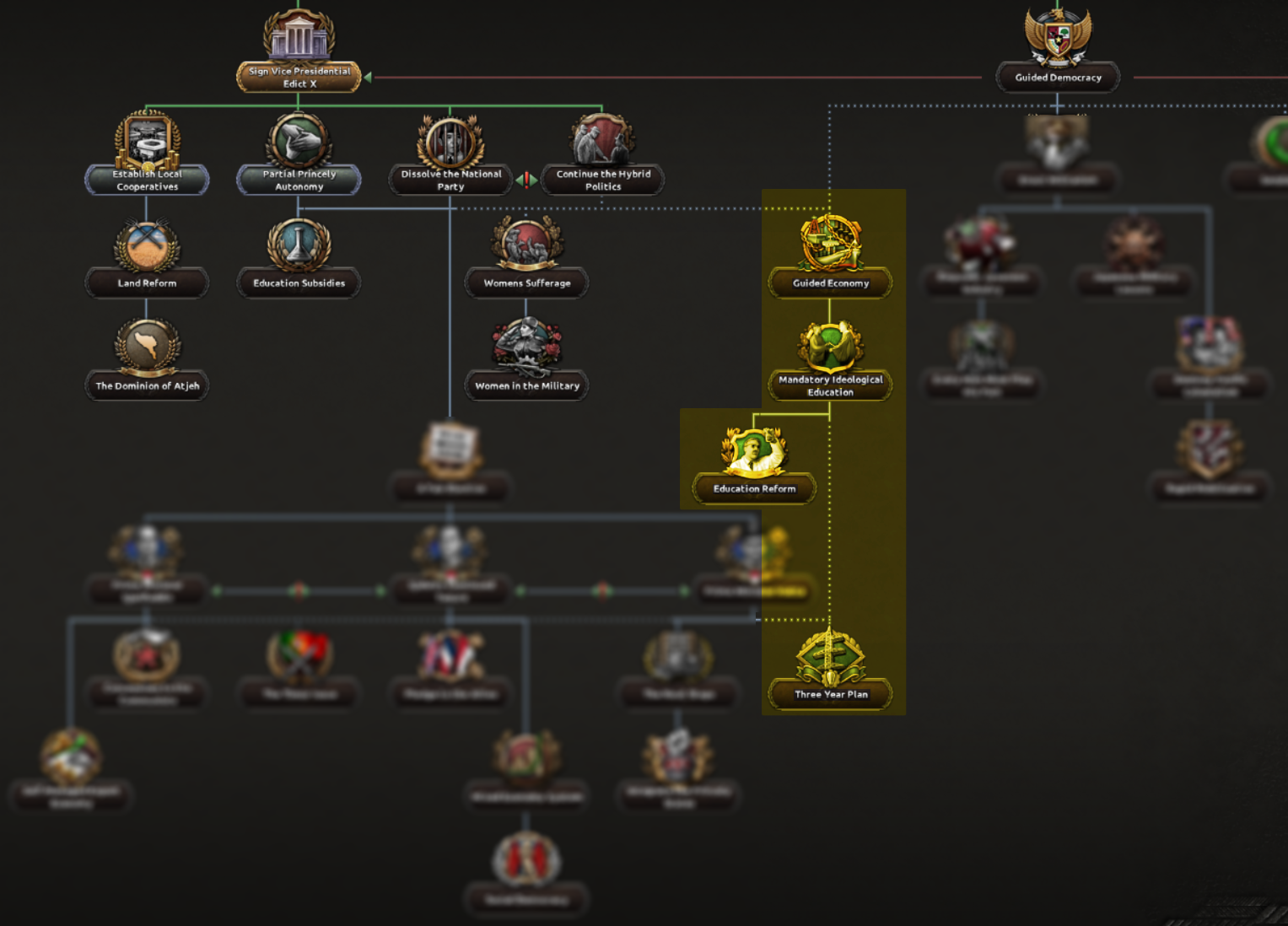 If you decide to continue with hybrid politics, Sukarno will be permanently locked as an advisor, giving you stability penalties. However, this also gives you access to some of the focuses in the unaligned path.
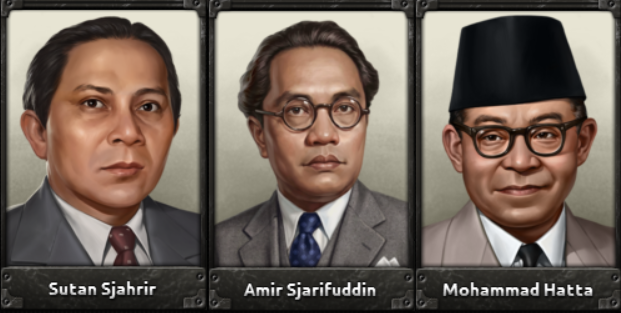 If you dissolve the national party and abolish the presidency, Sukarno will be removed, and you can hold Indonesia’s first democratic election. Each leader has his own mini-branch based on his policies.
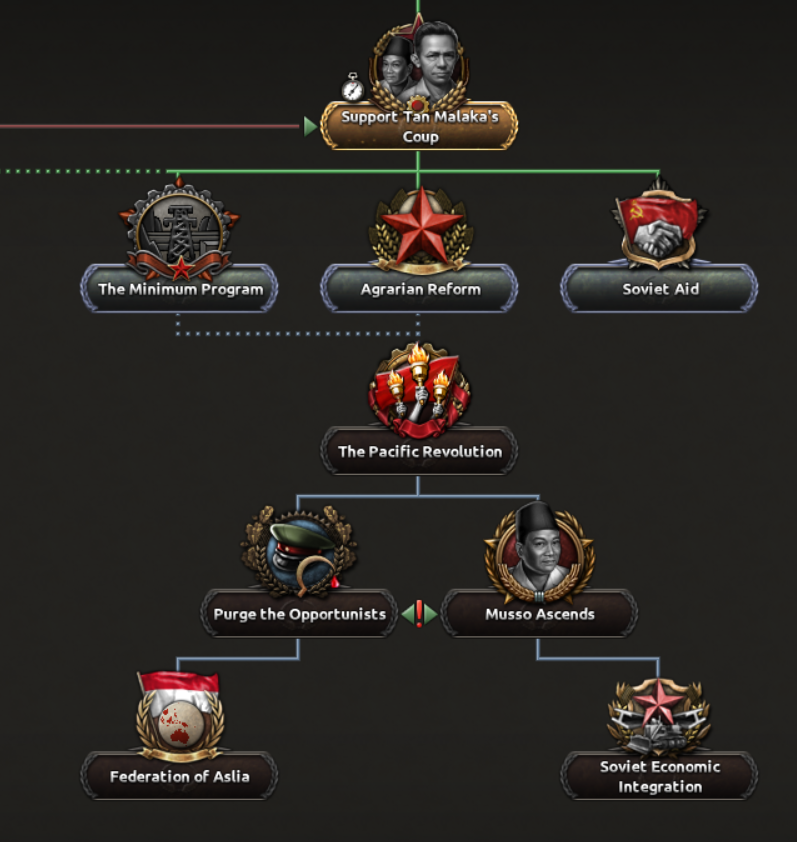 The communist path is based around the question of “What if one of Tan Malaka’s many attempts of taking over the government worked out?”, and begins with supporting his coup attempt.
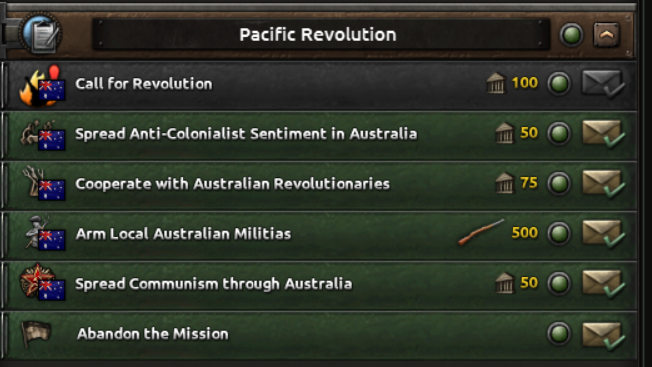 When the National Revolution is over, you will be able to spread it further, and declare the pacific revolution. This is done with decisions that let you focus on one country at a time, and help its local communist movements. Once the communist party has high enough popularity, you can call a revolution, and then move on to another country.
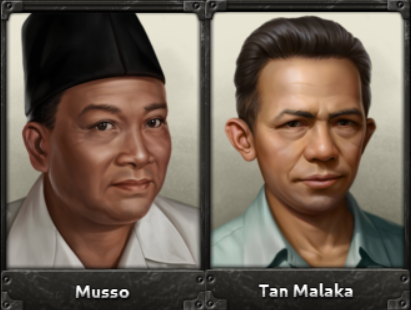 Tan Malaka is an interesting character to say the least. He is an anti-stalinist and a visionary. He has grand plans for a united pacific country called “Aslia”, which quite literally means “asia australia”.
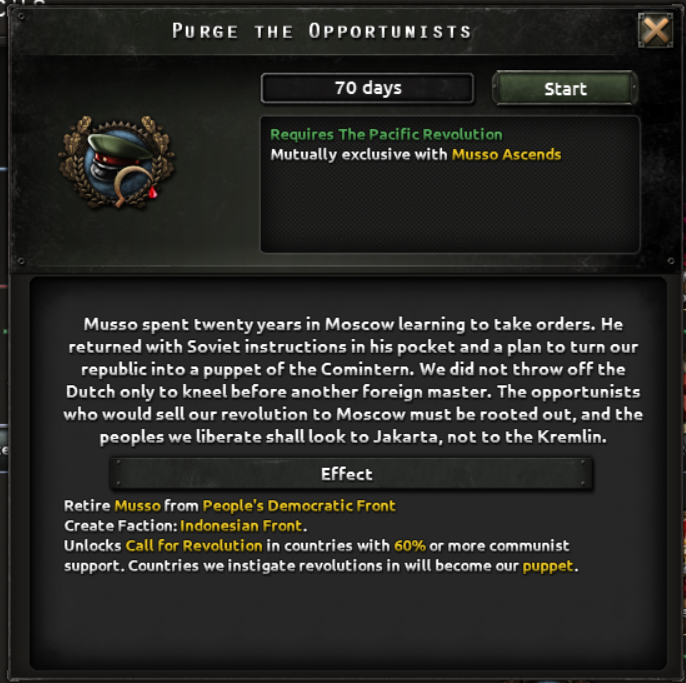 If Tan Malaka successfully ousts Musso from the party, Indonesia will be able to subjugate countries that join the pacific revolution.

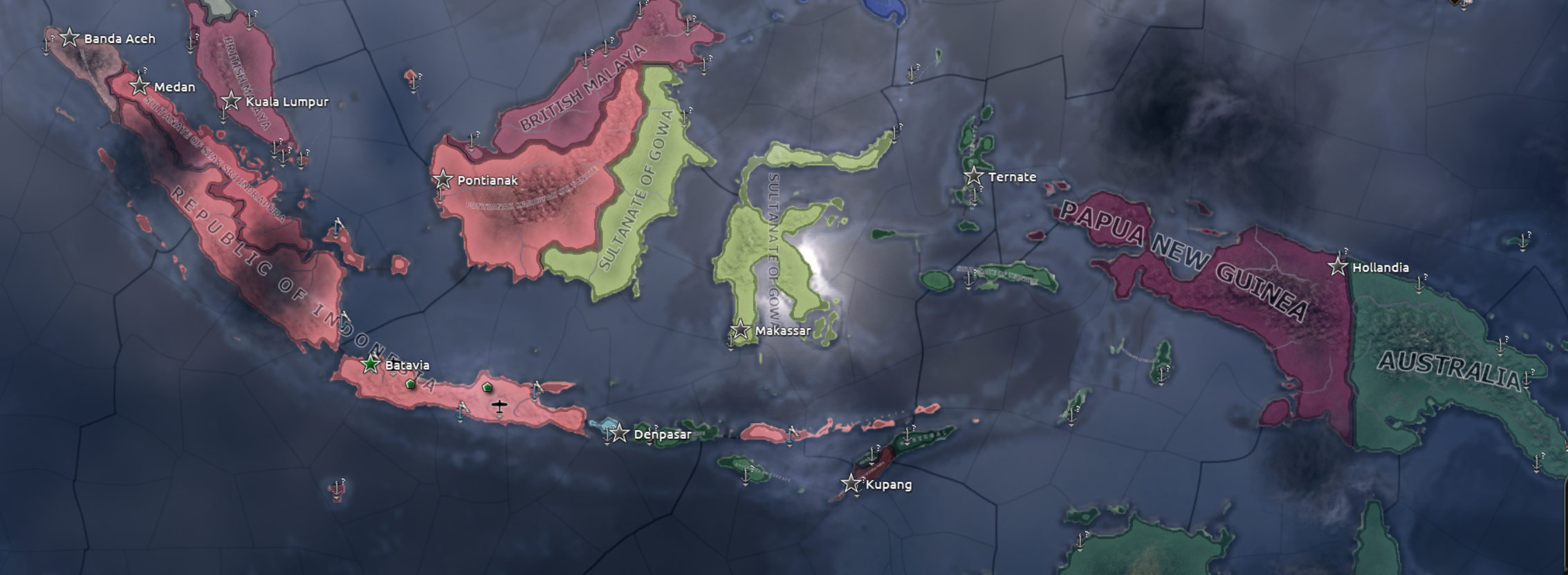 Map of Indonesia with all princely states released
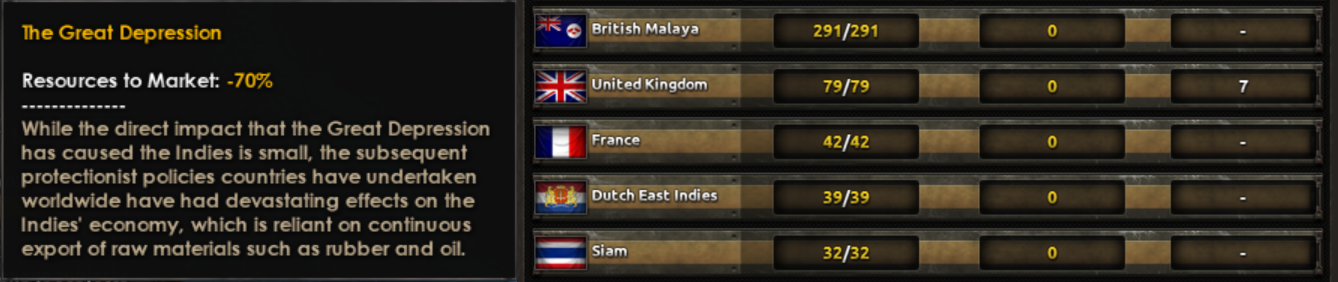 To represent this situation mechanically, Indonesia now starts with a national spirit which puts a heavy limit on how many resources Indonesia can export. Many focuses in the Industry branch will reduce the limit, however, it will often come at the cost of economic diversification.
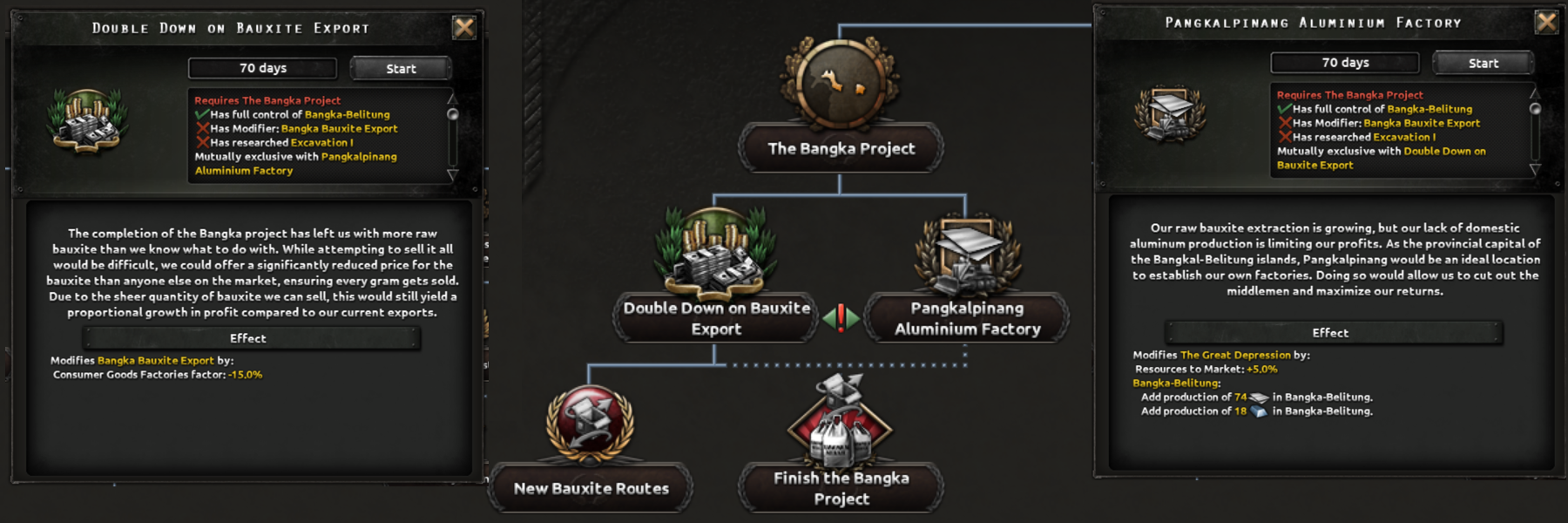 The Bangka and Belitung islands are home to a majority of Indonesian bauxite (for those unaware, bauxite is the raw ore that gets turned into aluminium), despite their small size. However, Indonesia lacks the infrastructure needed to actually produce aluminium, instead selling raw bauxite in bulk. When playing as Indonesia, you will be able to decide between continuing to sell raw materials, or building their own infrastructure.
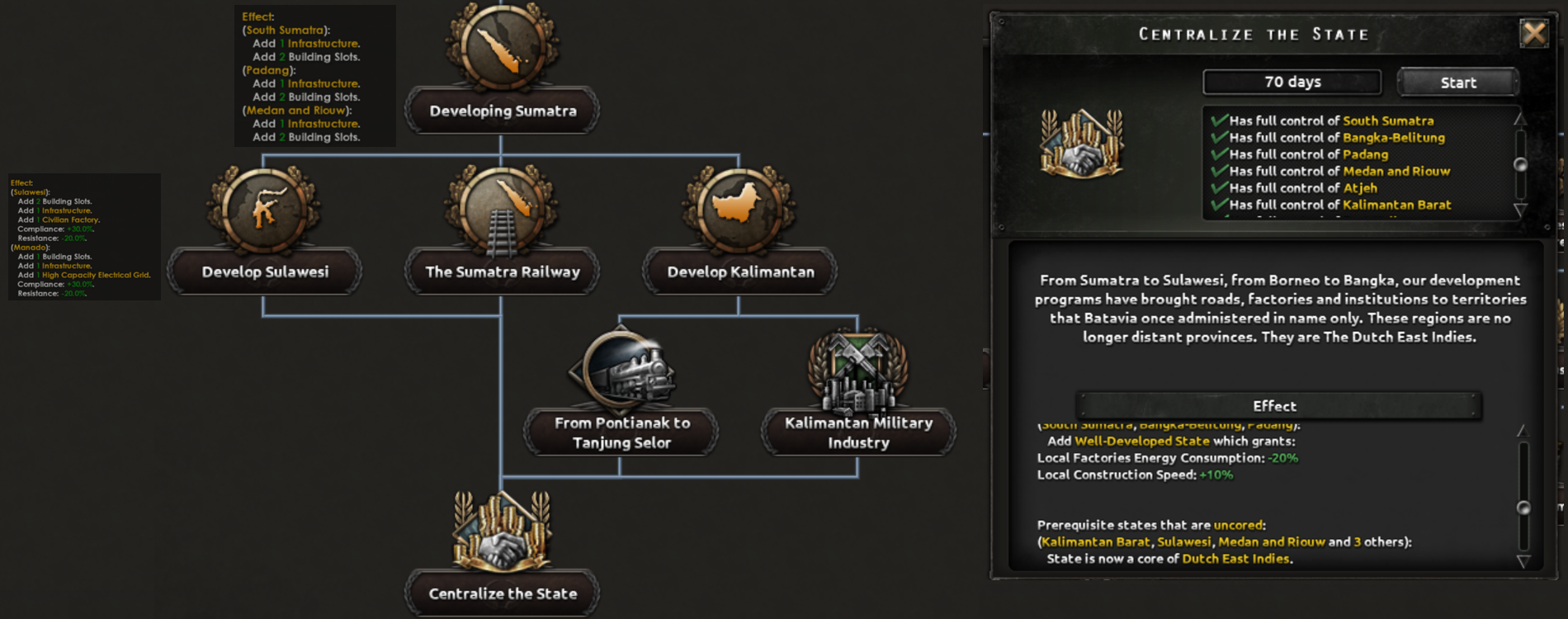 You can invest in underdeveloped regions, which eventually allows you to core certain princely states. Since there are several ways to core every state, we’ve made it so that any core state this focus would have cored will get a state modifier instead.
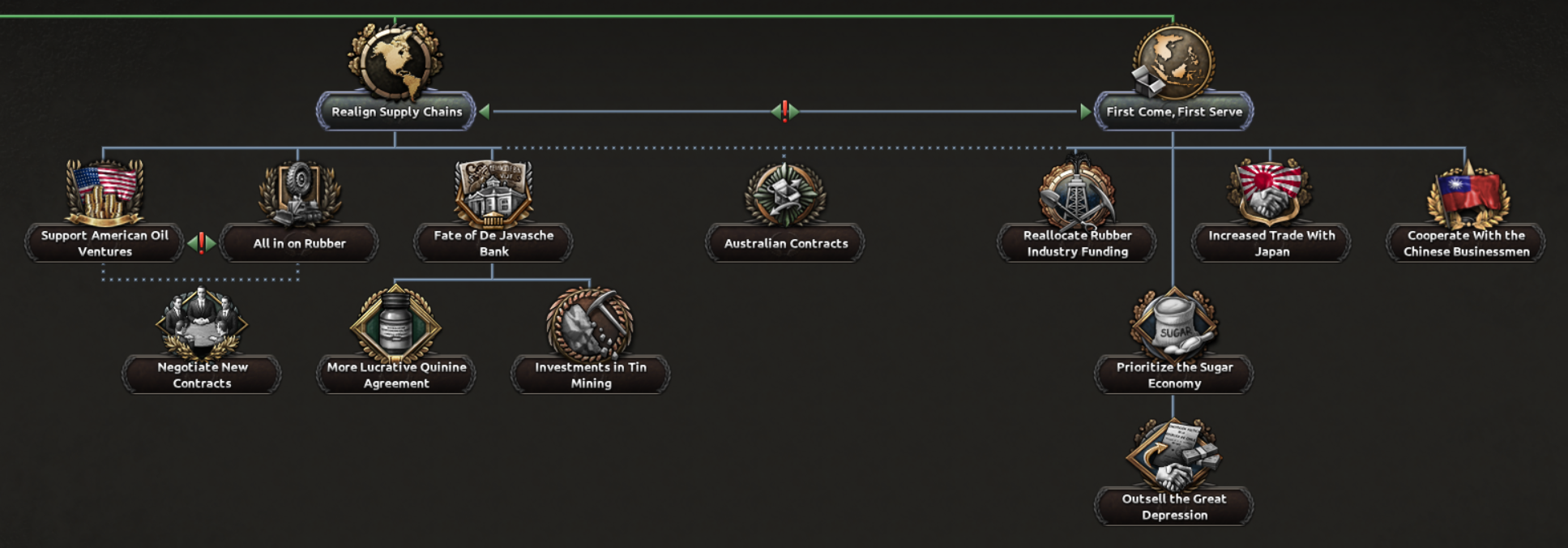 The biggest decision of the Industry branch is whether to work with western companies to sell off resources at cheap prices while building up a local industry, or to establish new deals within the Asian market, including Japan, which might make the Netherlands angry.
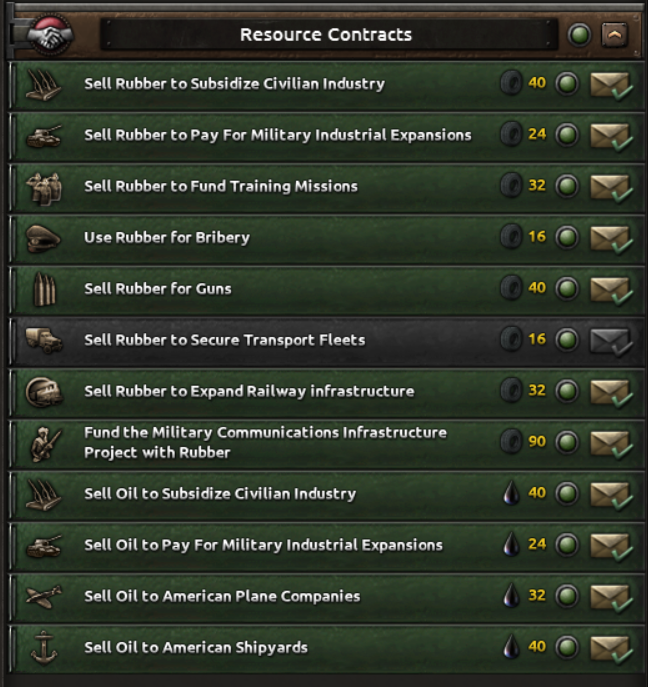 The resource market can be quite volatile, and since Indonesia’s economy is so dependent on exporting resources, we wanted to avoid situations where the player suddenly loses half of their civilian factories overnight due to market fluctuations. The Resource Contracts system helps counter this by letting Indonesia lease resources to private companies in order to pay for things such as civilian factories and weapons.
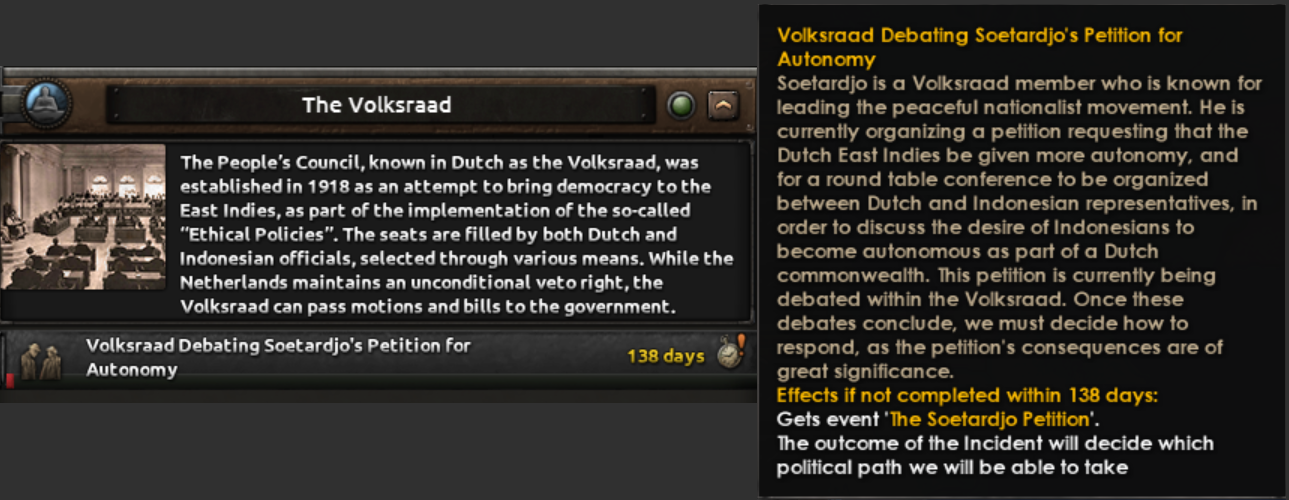 In 1936 a vote was held on whether or not to pass the Soetardjo petition, which called for Indonesia to gradually become autonomous under the Dutch crown, with a similar status as the British Dominions.
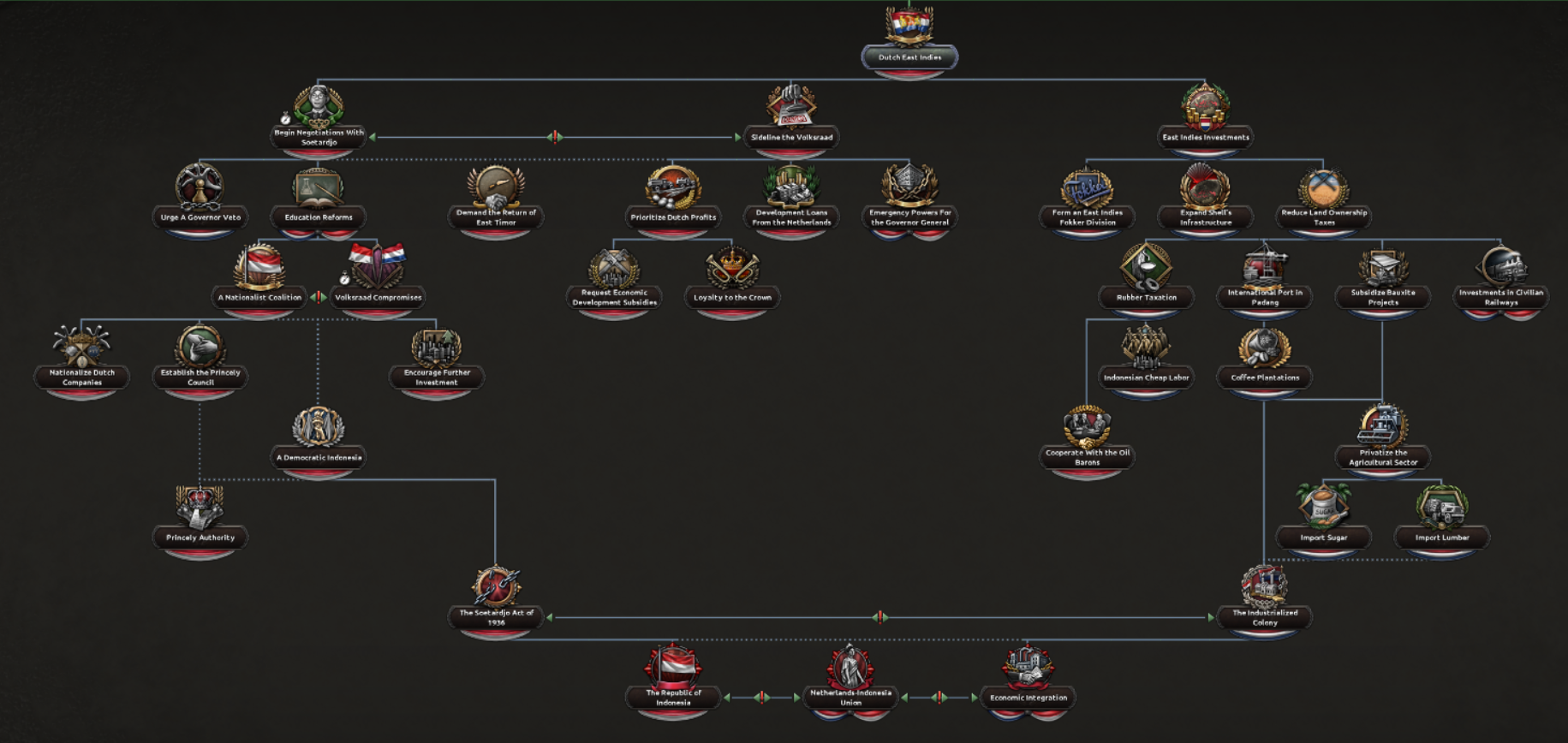 The right side of the tree is where the Netherlands can invest into the Indies (which reduces their autonomy), and the left side of the tree is where the Indies can work toward the goals established by the Soetardjo petition to gain autonomy. (unless the petition was rejected, which we will get to later)
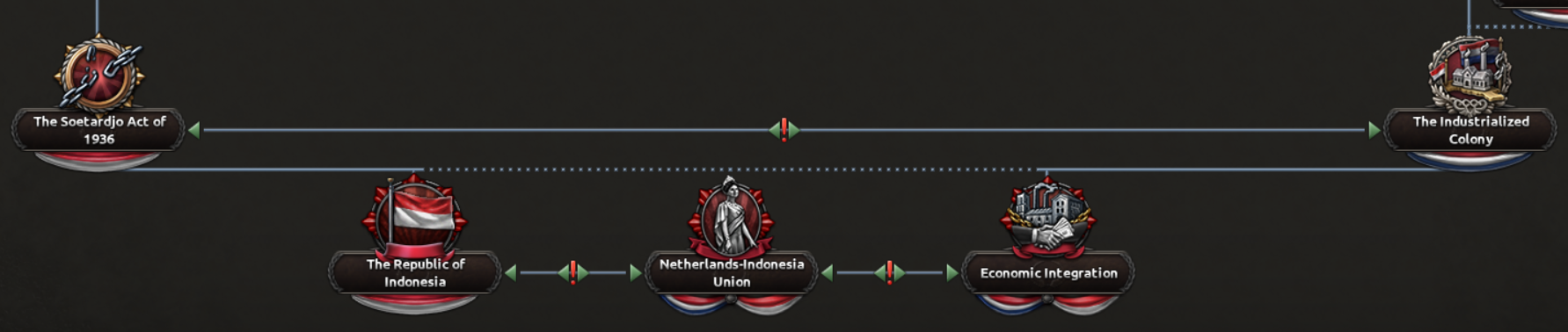 The Indies’ capstone can be taken if they complete all of the Soetardjo petition milestones, letting them declare independence. Whereas the Dutch capstone can be taken if they invest heavily into the colony, which will not only block the Indies from ever becoming independent, but will also force them to give large amounts of their industry to the Netherlands.
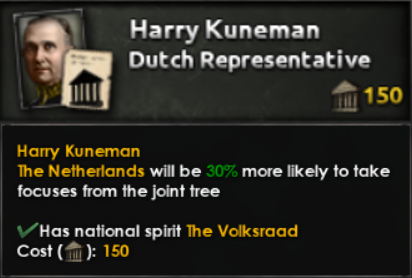 Despite this, when playing as the Indies you might still want the Netherlands to take some investment focuses, as they do significantly boost your economy. But this brings up an old issue with joint trees; It’s no fun waiting for the AI to complete a joint focus with no indication as to when or if they’ll actually get to it. To fix this, we added a modifier for how likely the AI will be to take joint focuses, which can be increased via certain advisors and focuses.
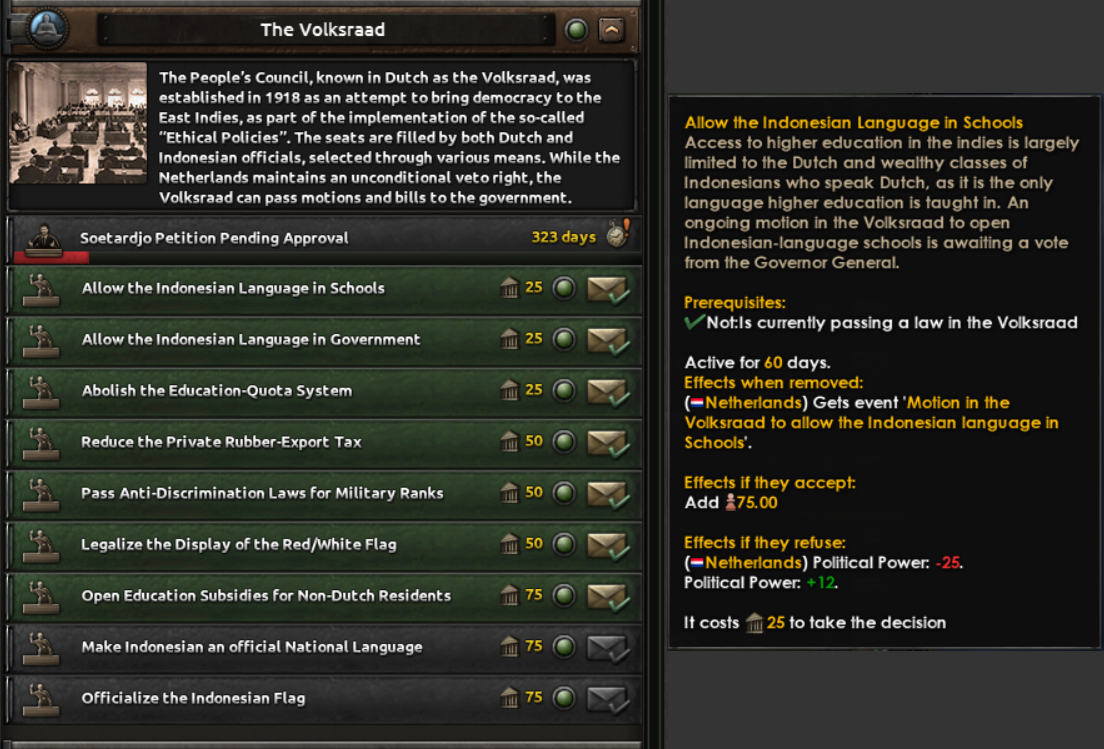 Historically, the Volksraad (People’s Council) was a semi-legislative council. It wasn’t exactly democratic, but it was the most democratic body of the Indies government. We’ve added a decision system to represent this, which can be used to attempt to pass laws to increase autonomy and boost the Soetardjo petition forward.
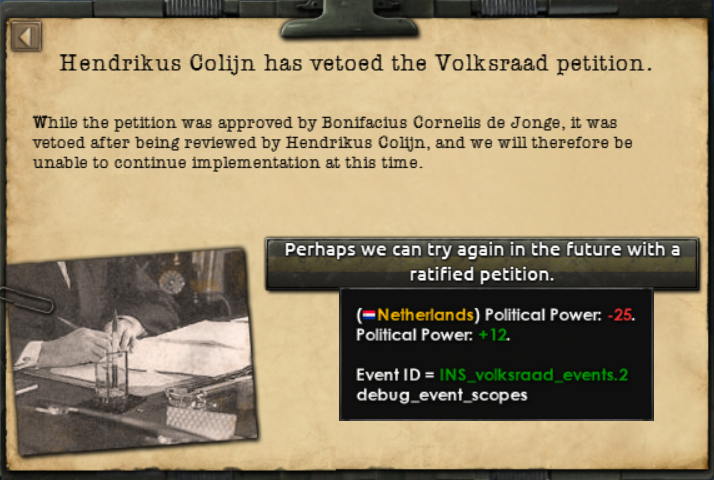 The Netherlands can always choose to veto a Volksraad petition, which will refund some of your political power, and you can try again later.
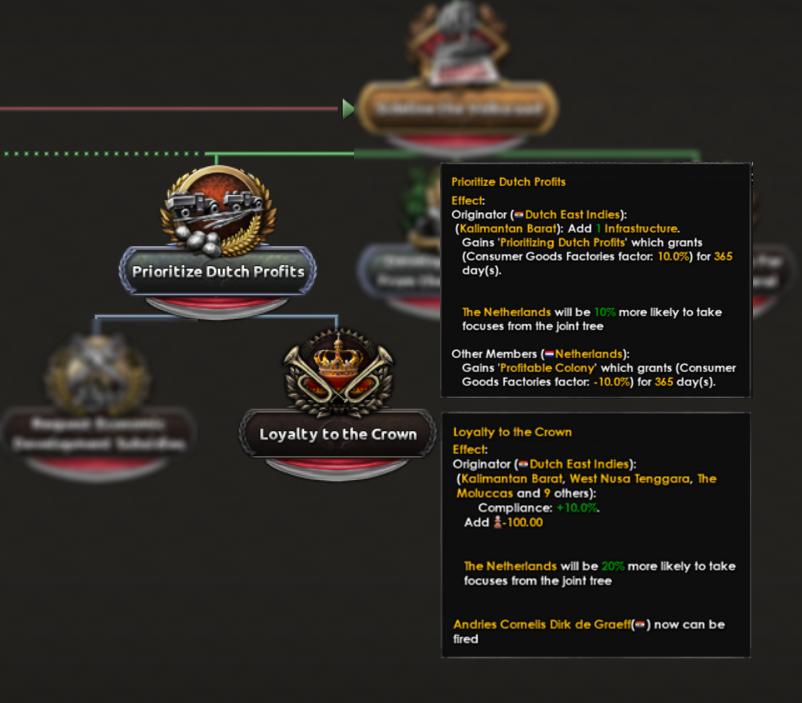 Returning to the political branch and the race to take the capstone, the previous explanation was assuming the East Indies supported the Soetardjo petition. However, If the East Indies rejects the Soetardjo petition, there is no race, as only the Dutch capstone is available, and the East Indies will never become independent. You might wonder why you’d voluntarily do this when playing as the East Indies, which is a good question.
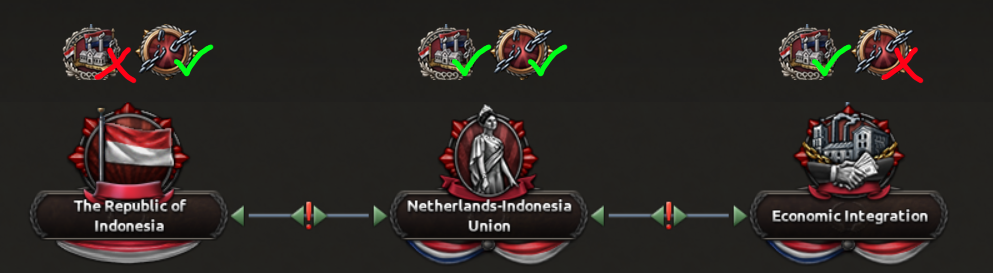 Depending on the capstone focus chosen, you can either complete the Republic of Indonesia or Economic Integration once you meet the requirements. Alternatively, the Netherlands-Indonesia Union is always available, but only during war.
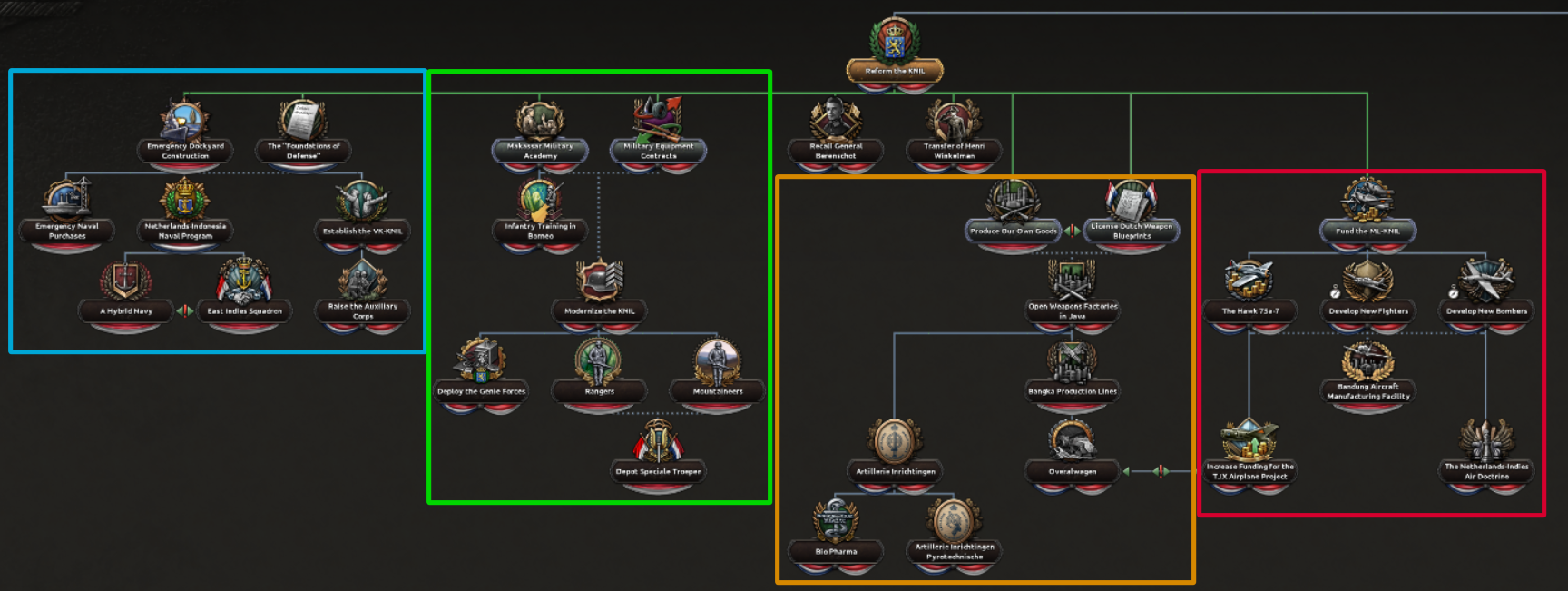 While the East Indies Army (the KNIL) was a fully independent organization from the Dutch army, the two armies were still very intertwined. After the Netherlands capitulated, they shifted focus to the East Indies.
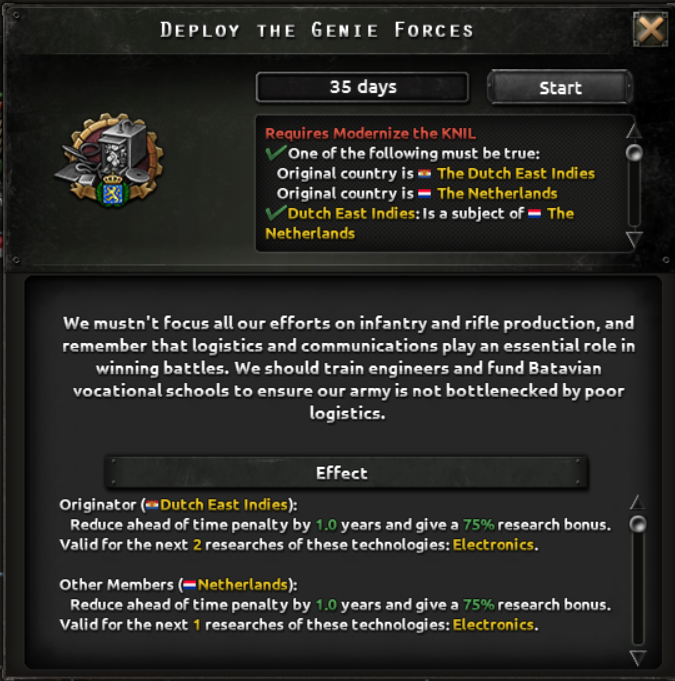 Most of the focuses follow a similar pattern; The originator gets the reward, the other country gets half the reward. The Netherlands will start prioritizing this branch quite heavily if they capitulate.
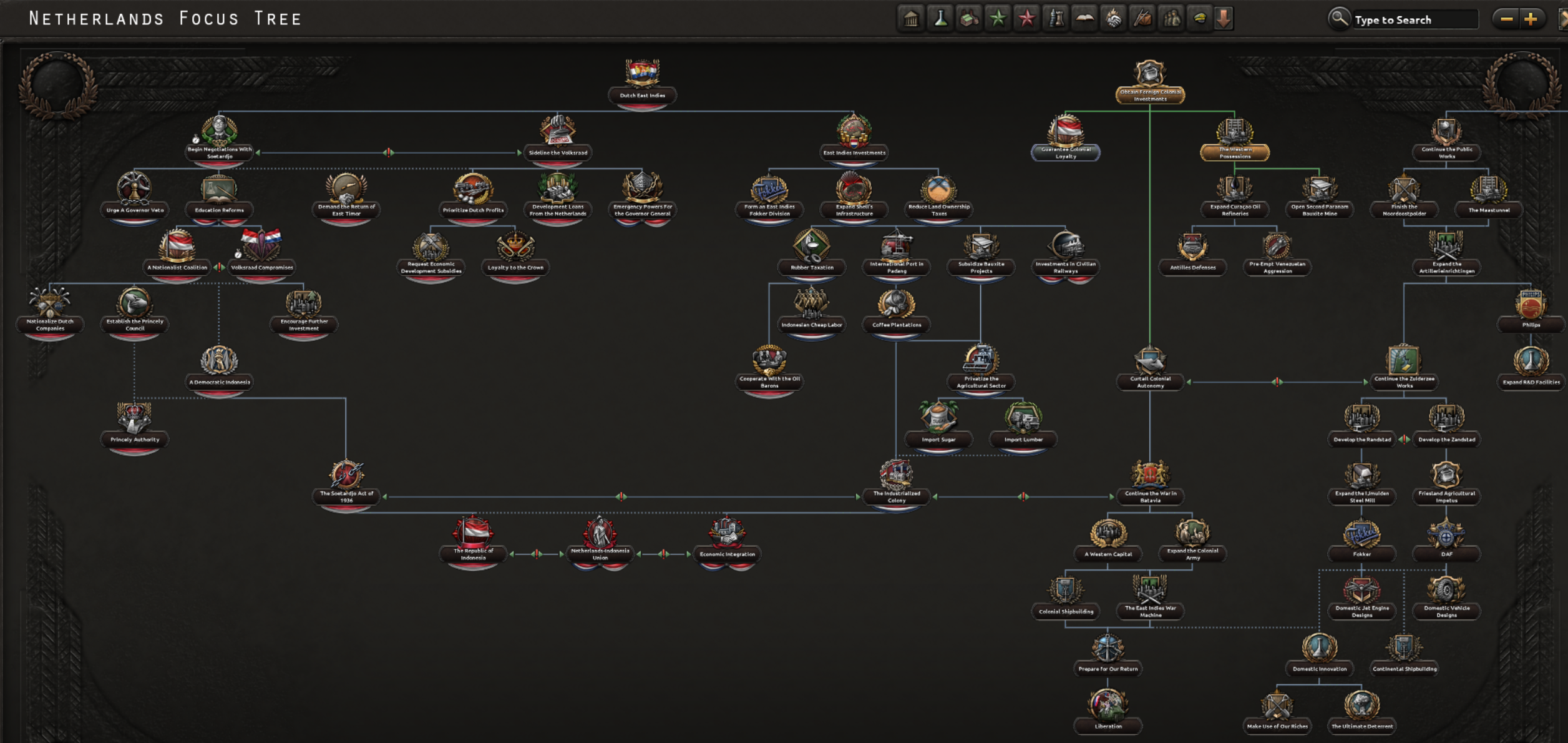 Aside from the addition of the joint focus tree, there have been a few minor changes to the Dutch tree to accommodate it. The reason for most changes is to ensure that the pacing of the Dutch tree is not thrown off by the addition of the new joint focus tree.
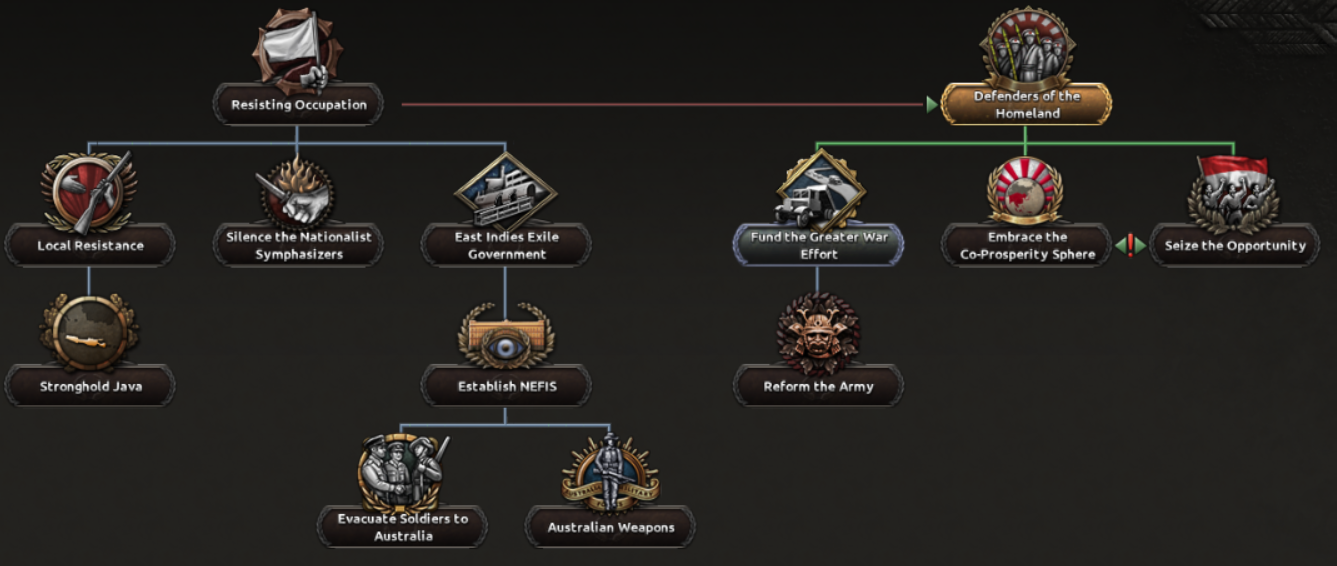 When Indonesia gets invaded by a major country, the “Resisting Occupation” branch is unlocked. It’s fairly straightforward, you can decide between moving all your forces to Java or trying to defend the whole archipelago.
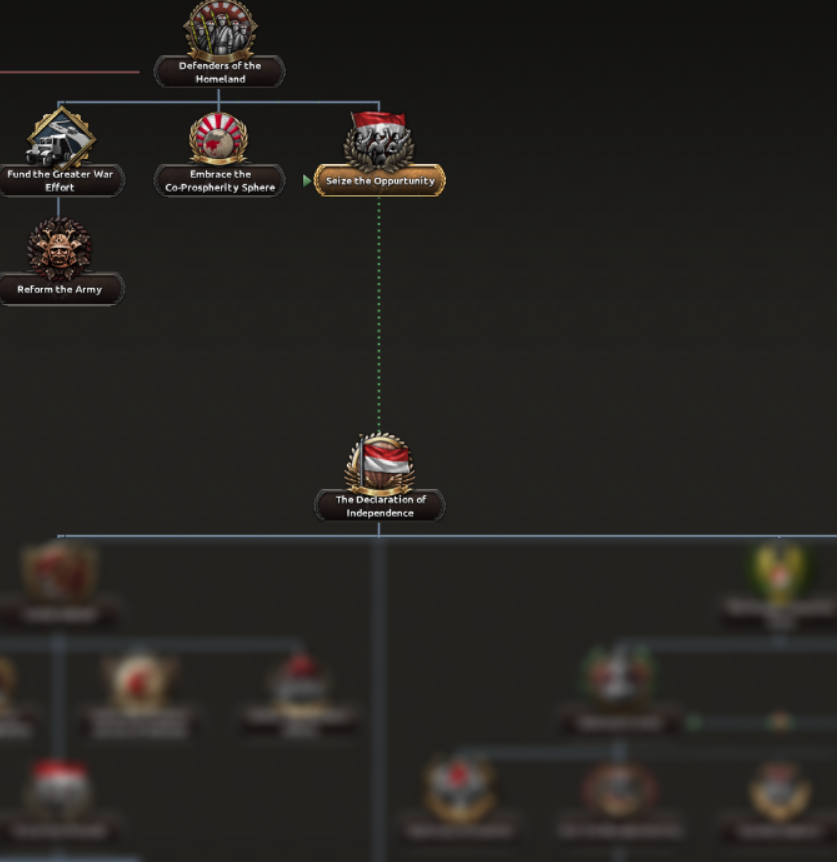 To solve that problem, we added a focus called Seize the Opportunity within the puppet branch. It’s only available if Japan is losing the war, and lets you completely switch your political branch mid-game to the revolutionary one.
 Open Beta Update VI Notes





 Award
Award 2
2


 Hoi4 - Nasıl Donanma Öğrenirim

 Министры Нацисткой Германии





 How to not go bankrupt buying HOI4 dlcs
 Как обновить свой мод в HOI4, не удаляя его из мастерской.


 Komendy do Hearts Of Iron IV


 Loading

